2010 MINI Cooper S Crank No-Start: Crank Sensor Circuit & DME
Quick Summary
A 2010 MINI Cooper S arrived on a hook after running rich for several days and then refusing to start. It cranked normally but the DME never saw engine speed, so there was no injection, no ignition and no fuel rail pressure request. Mechanical timing and compression were good. The engine harness had been probed and butchered by a previous repair attempt, including MAF wiring wrapped in aluminum foil that sparked on removal. Wiring repairs alone did not restore the crank signal — scope and bench testing showed the DME had stopped biasing the crankshaft sensor signal line. A 10 kΩ pull-up from the 5 V reference restored the signal and the engine started. With new sensors, repaired wiring, a leaking oil pressure sensor replaced and a proper AGM battery installed, the car starts instantly hot or cold, idles smoothly and road tests without stalling. A matched replacement DME was recommended for the one remaining symptom: a hard 5,000 RPM ceiling.
- Vehicle
- 2010 MINI Cooper S (R56, N14 1.6L Turbo)
- Difficulty
- ★★★★★
- Repair Time
- 2 weeks
- Outcome
- Starts hot and cold, road tested, returned to customer
Fault Codes
2983 — Inlet Camshaft2BD4 — Sensor Supply 3 Out Of RangeA0B1 — CAS: Selector Lever / Clutch Input ImplausibleA0B4 — CAS: Engine Start, Starter Operation
Vehicle Information
| Year | 2010 |
|---|---|
| Model | Cooper S |
| Chassis | R56 |
| Engine | N14 1.6L Turbo |
| Transmission | 6-speed manual |
| Mileage | 131150 |
Repair Timeline
- October 2025 History Cooling system repairs, battery and A/C clutch completed. Vehicle starts and runs normally.
- Months later History Another party attempts to diagnose a rich-running complaint. Probe holes left in the engine harness and MAF wiring wrapped in aluminum foil.
- July 2026 Complaint Vehicle runs rich and rough for several days, then will not start. Towed in as a crank/no-start.
- Week 1 Diagnosis No engine RPM at the DME while cranking. No injection, no ignition, no rail pressure request. Mechanical timing and compression verified good.
- Week 1 Diagnosis Harness damage mapped and repaired. Crank sensor signal circuit scoped and bench tested. DME found not biasing the crankshaft sensor signal input.
- Week 2 Repair 10 kΩ pull-up installed from the 5 V reference to the crank sensor signal line. Engine started for the first time since it was towed in.
- Week 2 Repair Sensors, connector, oil pressure sensor and AGM battery replaced. Crank, cam, oil pressure switch, TMAP and MAF wiring repaired.
- Week 2 Verification 20+ minute road test in varying conditions. No stall, no reduced power event, no active DME faults. Hard 5,000 RPM ceiling remains.
- July 2026 Customer Vehicle returned with a recommendation to source a matched replacement DME.
Customer Complaint
The customer reported that the car had been running rough and, in his words, running rich for several days. He was watching live data on an aftermarket display plugged into the OBD-II port, which is how he formed that impression. The condition worsened until the car would no longer start. Between the first complaint and the vehicle arriving here, someone else had already attempted to diagnose it.
Symptoms
- Engine cranks at normal speed but never fires
- No engine RPM displayed by any scan tool while cranking
- No injector activity, no ignition, no high-pressure fuel request
- Reported rich running and rough idle for several days before the no-start
- Earlier history of stalling and a Reduced Engine Power warning
- Slow cranking and voltage drop on the existing non-AGM battery
Diagnostic Process
Establish what the DME can and cannot see. The single most important fact in this repair was found in the first hour: while cranking, the DME reported zero engine speed. Everything downstream — injection, ignition, rail pressure — is gated on that one input. Chasing the rich-running complaint before restoring engine speed recognition would have been wasted time.
Rule out mechanical failure. Because a jumped timing chain produces the same "no synchronization" picture on an N14, mechanical timing was verified and a compression test was performed on all four cylinders. Both were good. A carbon deposit found at the base of one spark plug's threads turned out to be a sealing issue, not evidence of a rich cylinder.
Inspect the harness before trusting any signal. The engine harness showed multiple probe holes from the previous diagnostic attempt. The MAF wiring had been wrapped in aluminum foil, which sparked while being removed. Damage was also found in the crankshaft sensor, camshaft sensor, oil pressure switch and TMAP circuits, and the camshaft sensor connector was broken. Every affected circuit was checked for shorts to ground, shorts to 12 V and shorts between adjacent wires with the battery and DME disconnected, and the sensor grounds and 5 V supplies were load tested rather than trusted on continuity alone.
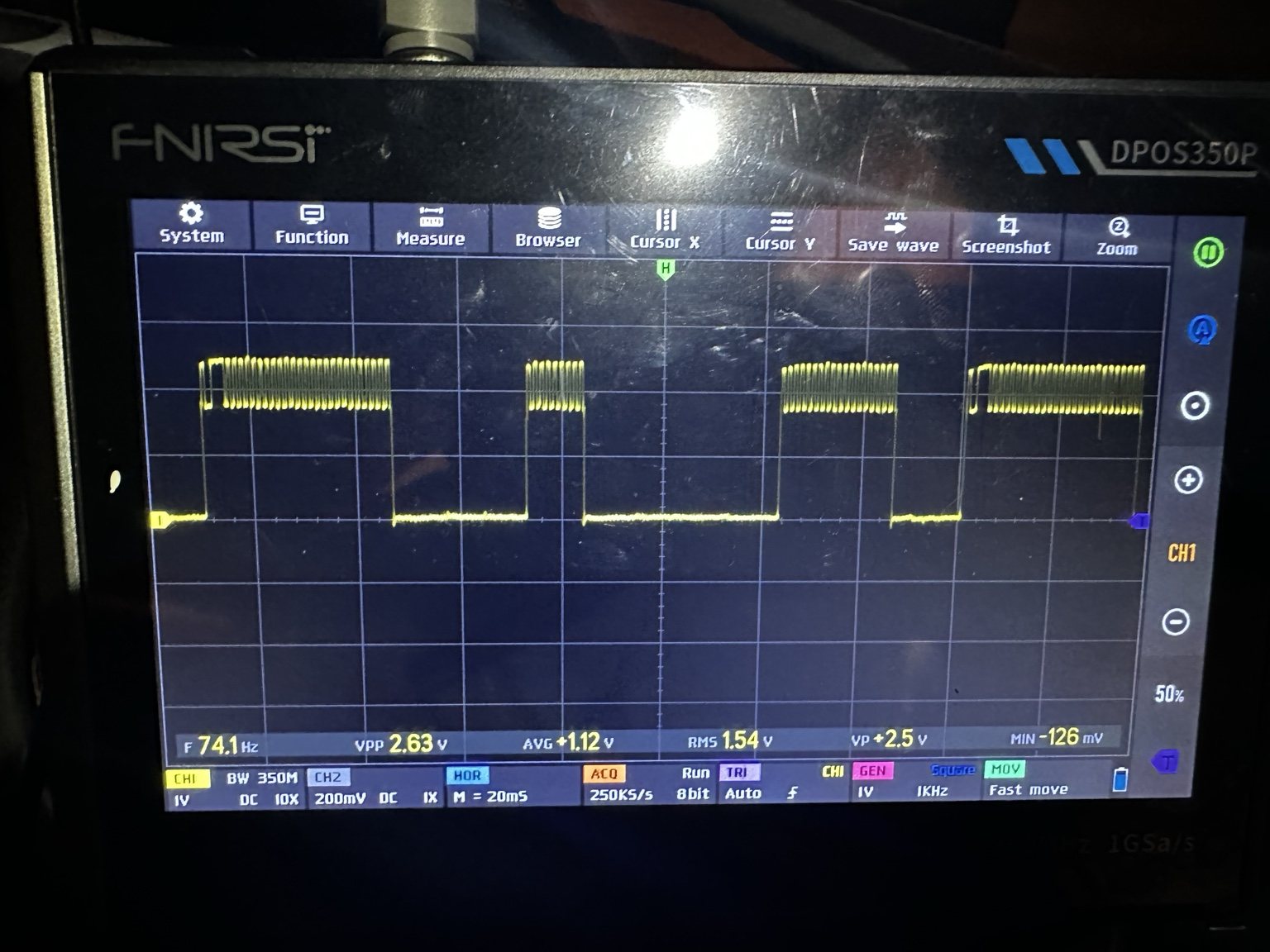
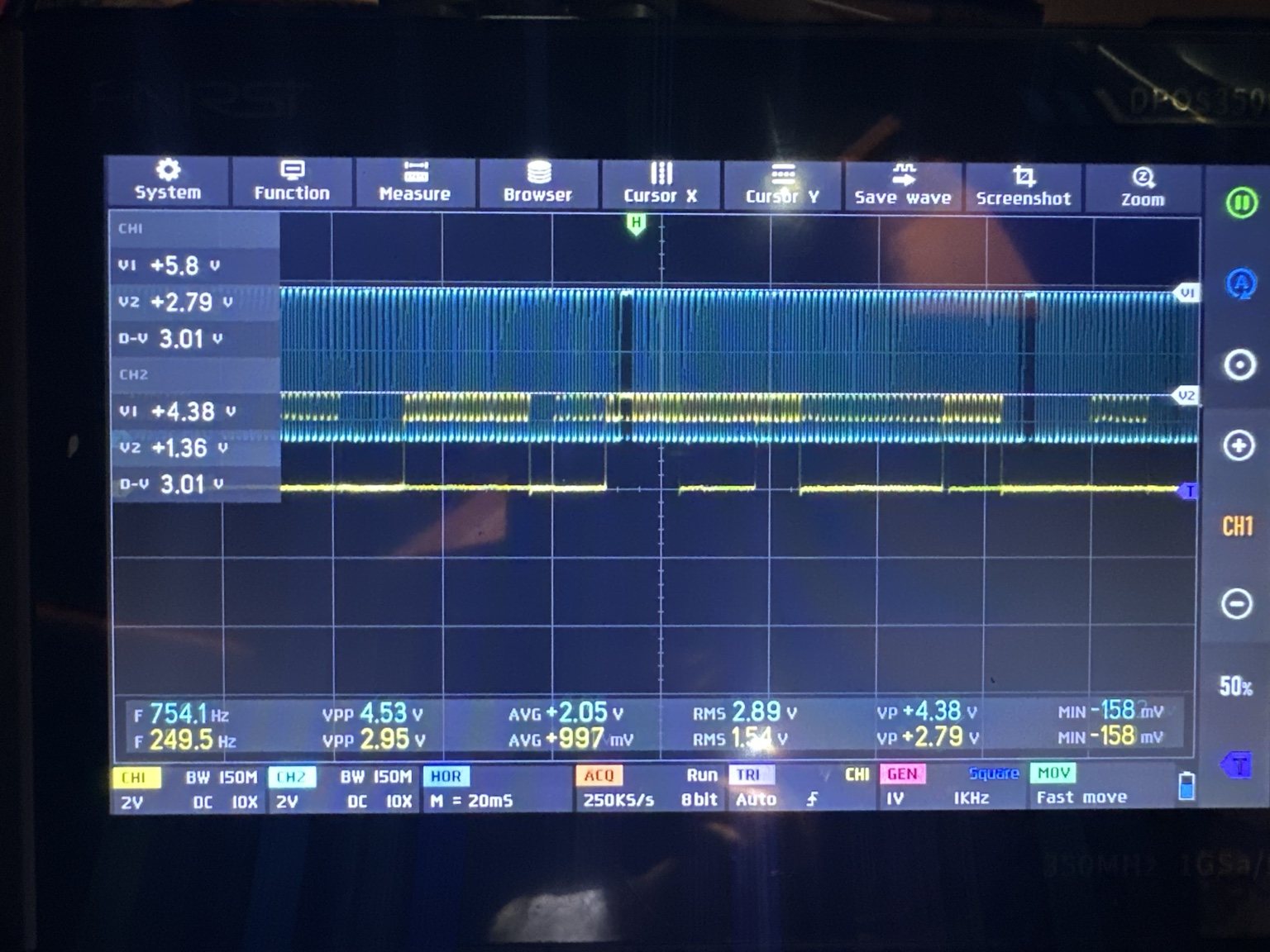
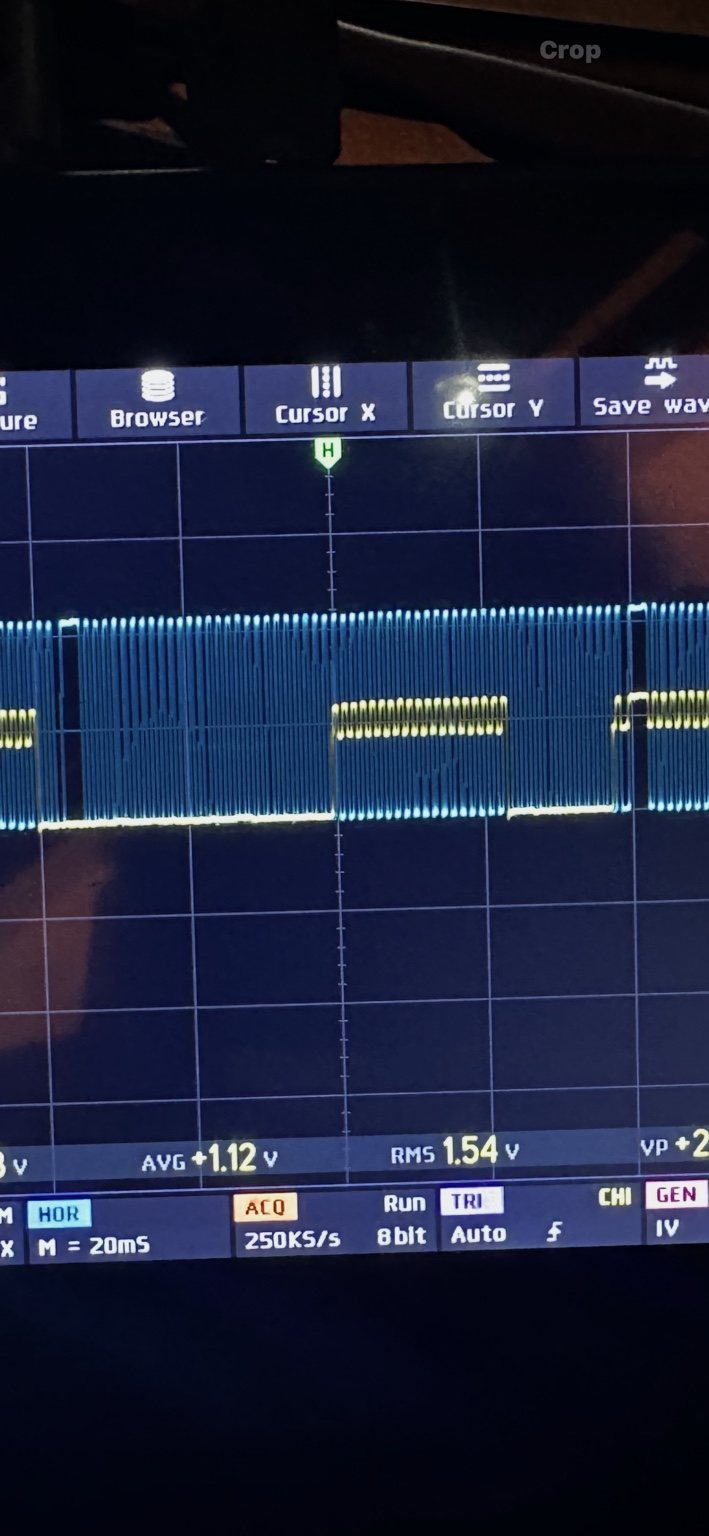
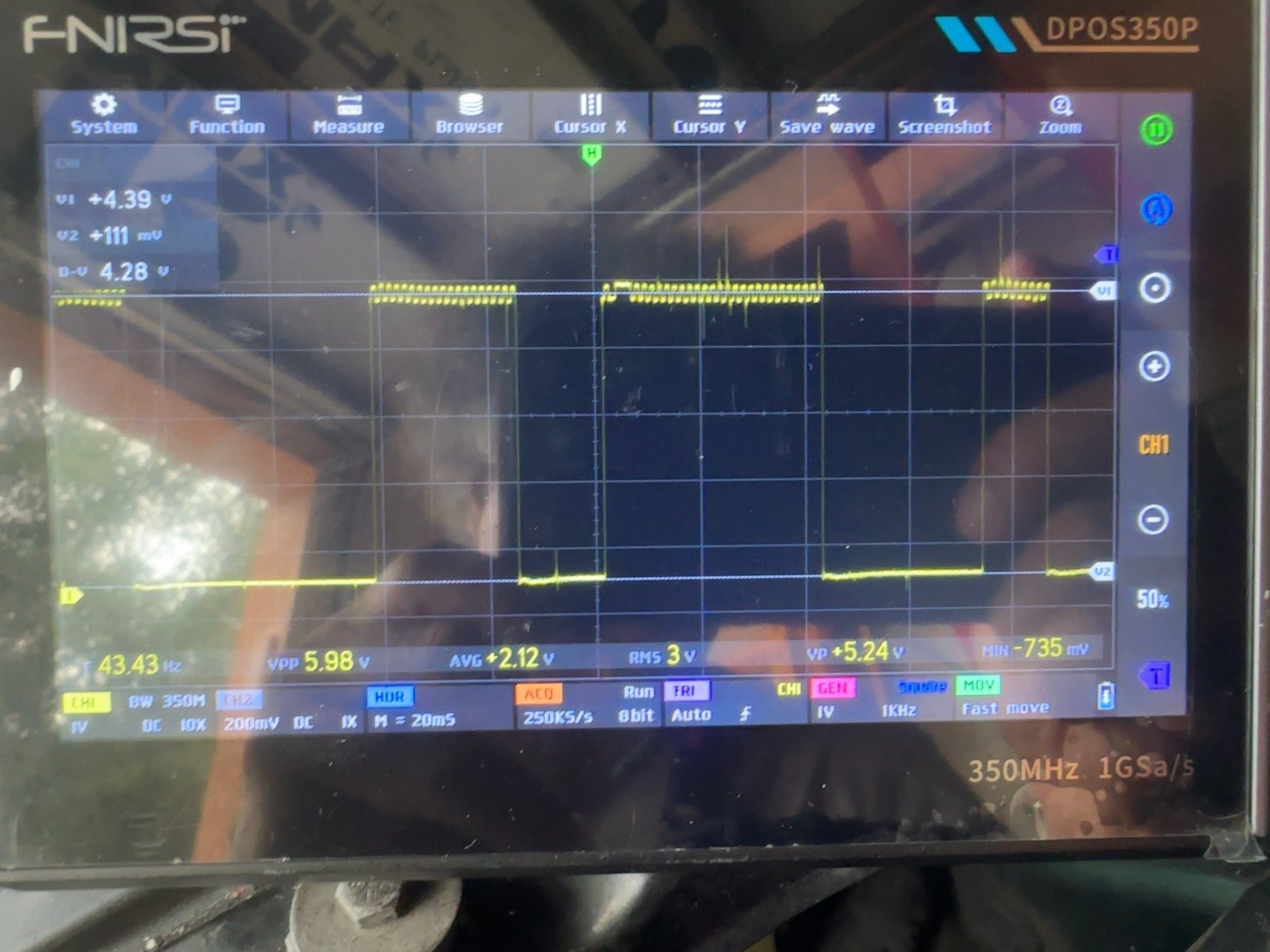
Scope the crank sensor circuit. With the sensor connected the signal line stayed flat during cranking. A bench test of the sensor with an external supply confirmed the sensor itself switched correctly, which pointed at what was supplying the signal line rather than what was pulling it down.
Test the DME's input, not just the sensor. A Hall-effect crank sensor of this type does not drive the signal high on its own — it switches a line that is held high inside the module. Measuring the signal wire with the sensor unplugged showed the DME was not holding it up. Jumping the 5 V reference to the signal line through a 10 kΩ resistor restored the bias, and the engine started immediately. Stored fault 2BD4, a sensor supply fault Bosch itself lists as an ECU repair indicator, supported the same conclusion.
Verify authorization separately. Codes A0B1 and A0B4 from the CAS module were traced to the clutch input circuit and a homemade clutch switch bypass left by an earlier owner, not to a fault in the starting system. The car had also had its CAS module cloned and keys made previously, and the DME had been replaced and cloned at some point before this visit.
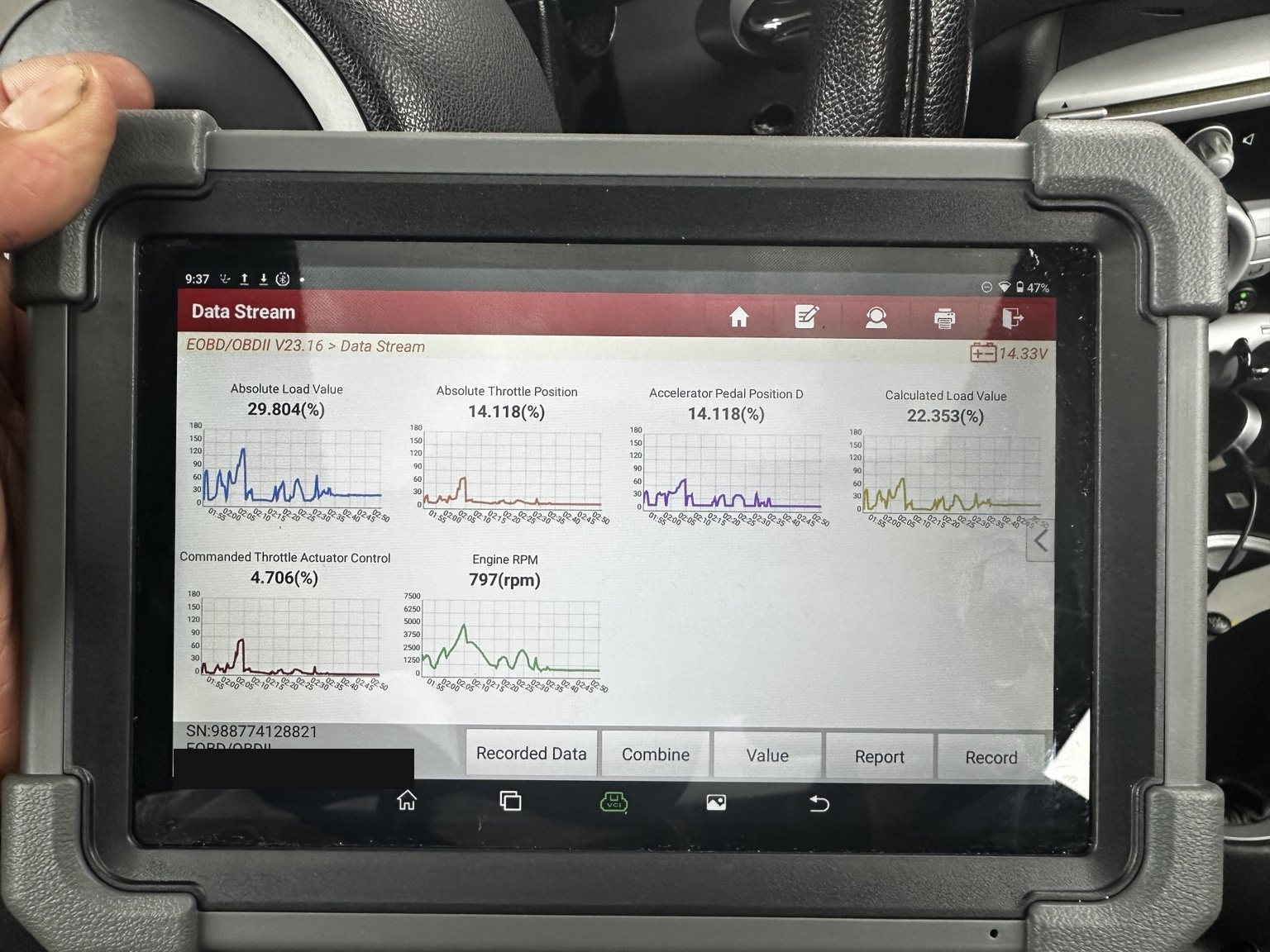
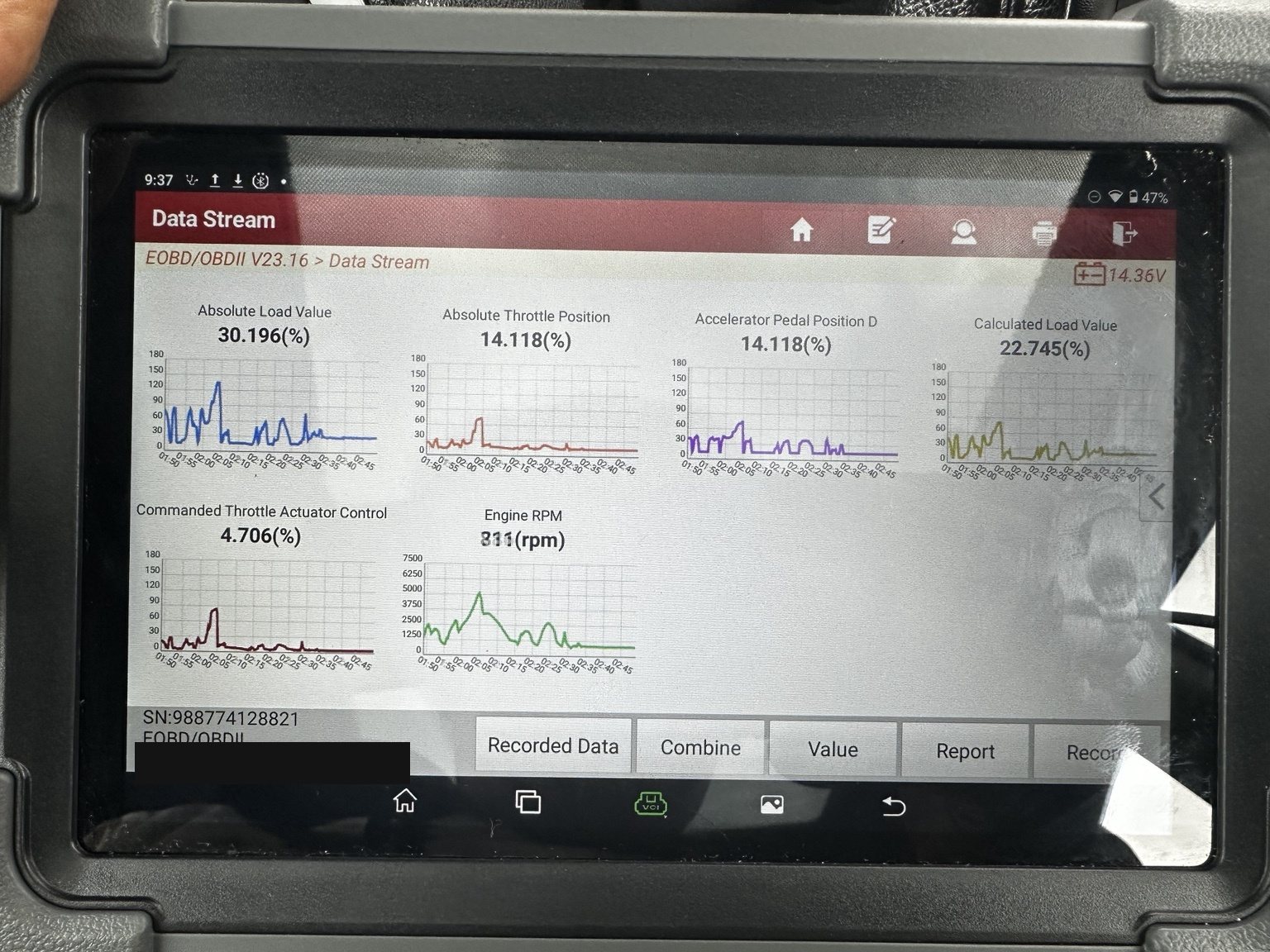
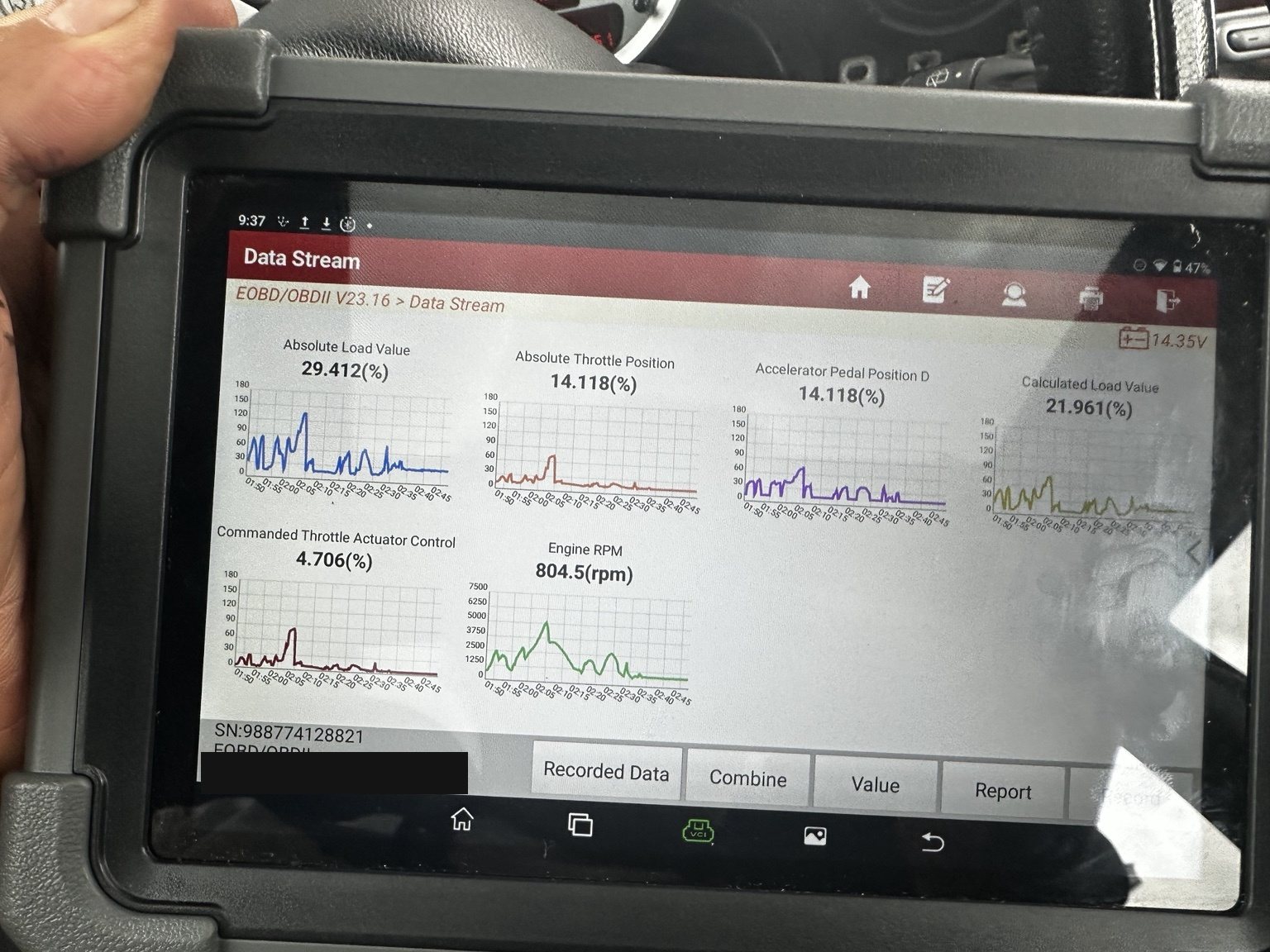
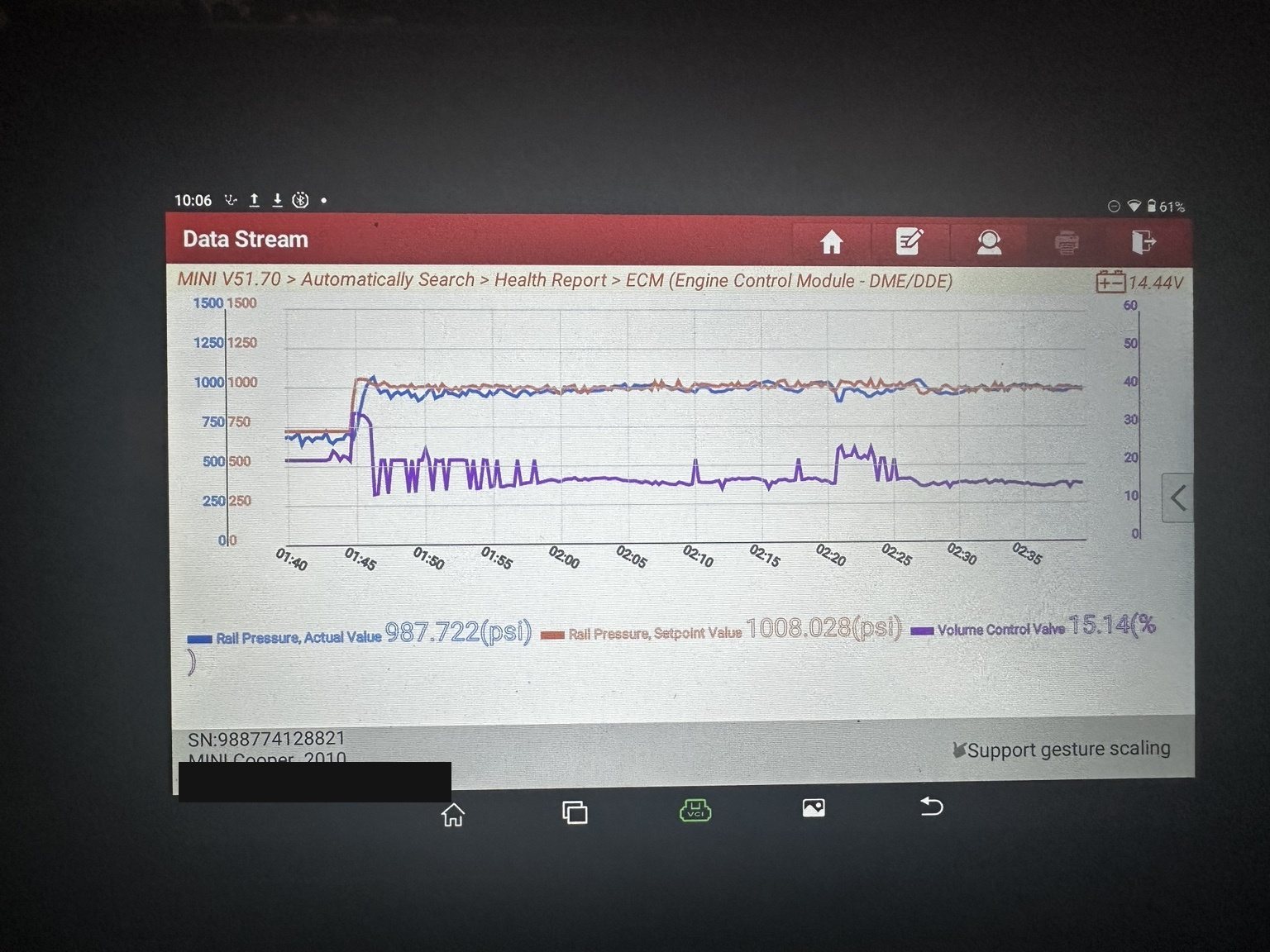
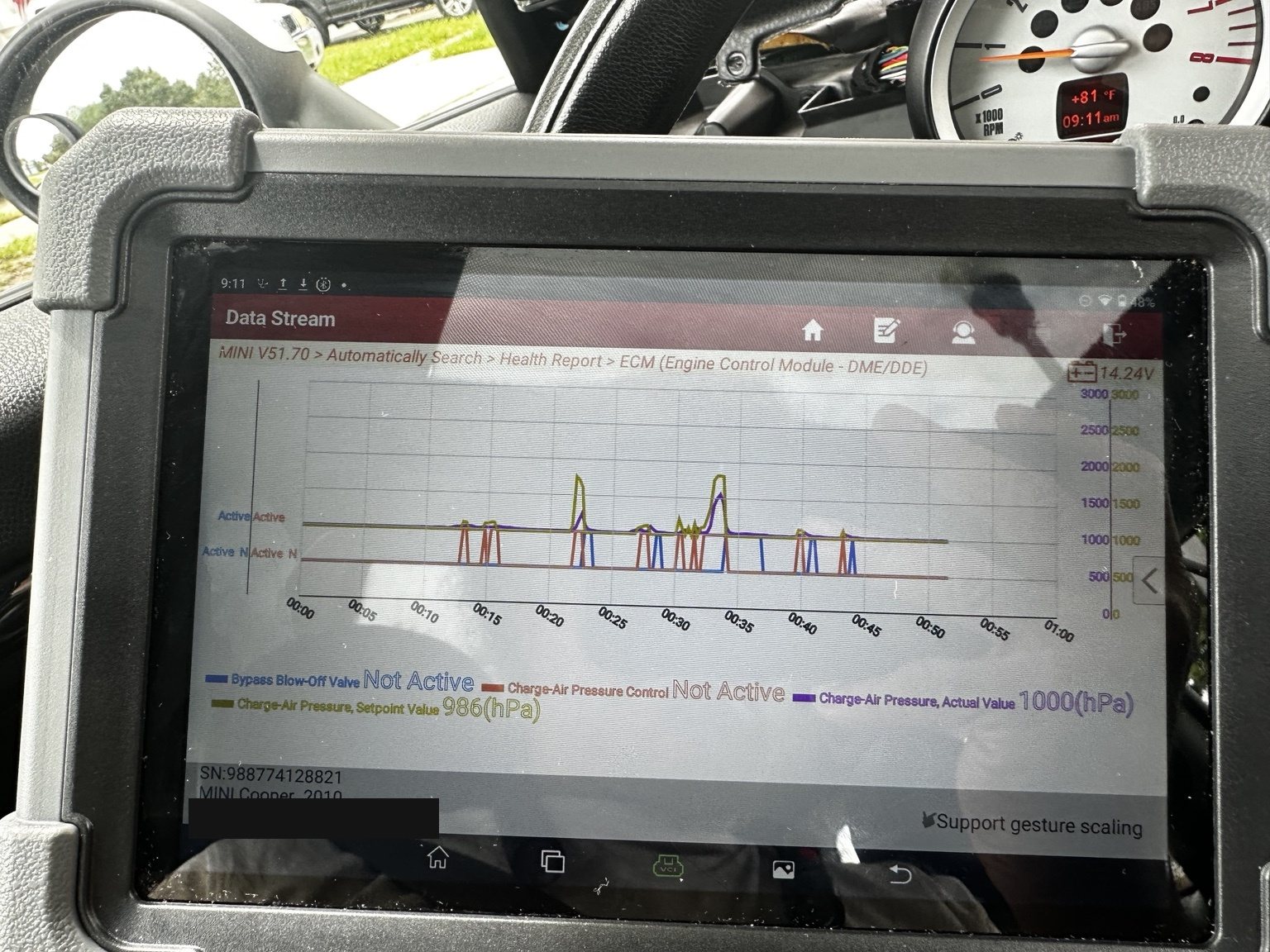
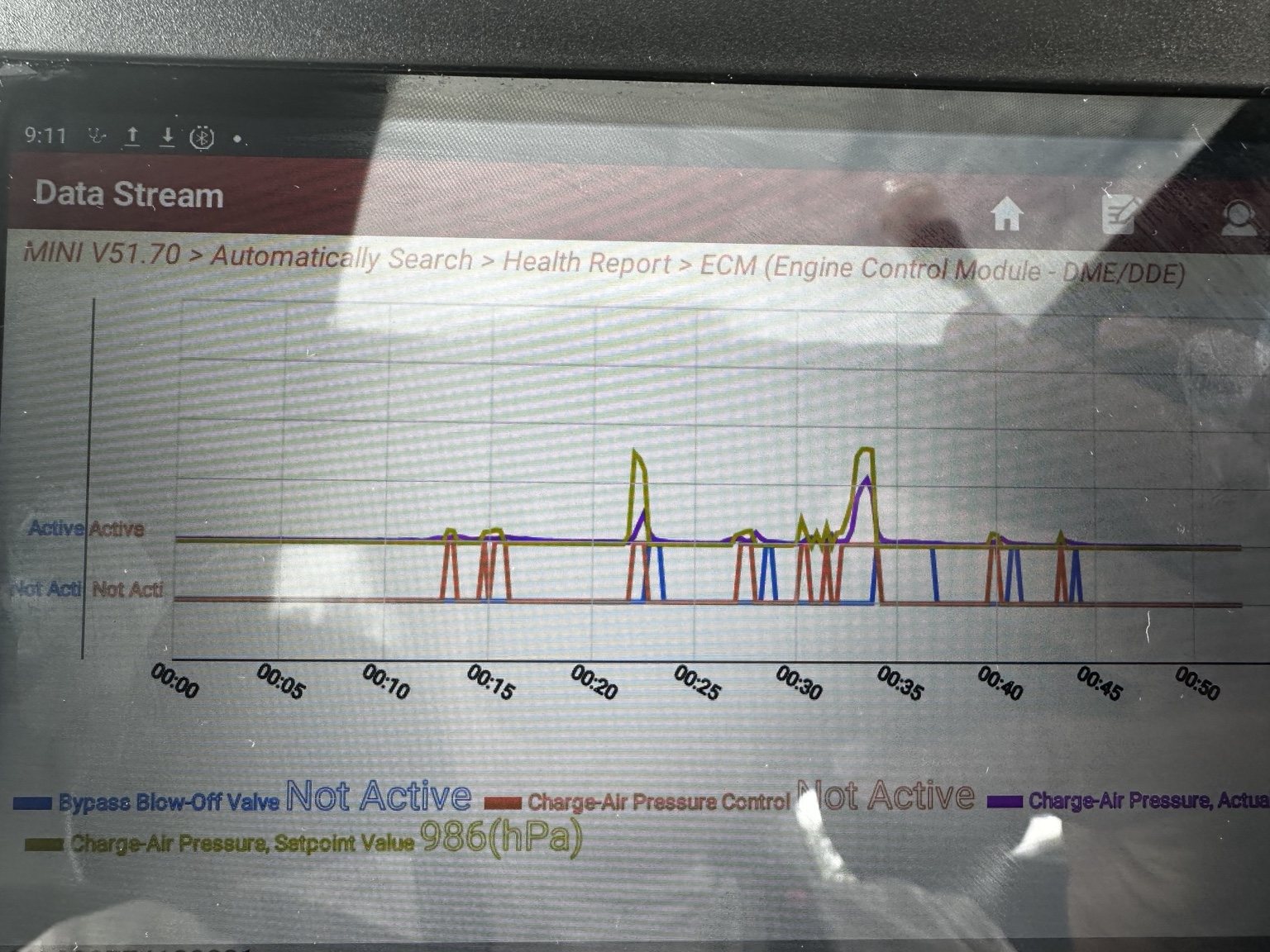
Resolve the remaining running faults. With the engine running, live data was used to confirm fuel rail pressure was correct, LPFP adaptation was normal and VANOS commanded and actual positions tracked, which cleared the HPFP and low-pressure pump from the list. Intake camshaft fault 2983 was evaluated after the engine could run rather than before.
Repair Performed
- Replaced the crankshaft position sensor
- Replaced the camshaft position sensor and its damaged connector
- Repaired the crankshaft position sensor wiring
- Repaired the camshaft position sensor wiring
- Repaired the oil pressure switch wiring
- Repaired the TMAP sensor wiring
- Repaired the mass air flow sensor wiring
- Replaced the leaking oil pressure sensor
- Installed a new 70Ah AGM battery
- Installed a pull-up on the crankshaft sensor signal circuit to restore engine speed recognition and allow the engine to start and diagnosis to continue
Parts and labor came to $841, including the initial diagnostic.
Parts Used
- Crankshaft Position Sensor Replacement
- Camshaft Position Sensor Replacement
- Camshaft Position Sensor Connector Replacement
- Oil Pressure Sensor Replacement
- AGM Battery AGM70Ah H6 Group 48
Verification
- Immediate starting verified from both cold and hot
- Stable idle and smooth running confirmed
- Fuel rail pressure verified correct while running
- VANOS commanded and actual positions verified tracking
- Multiple road tests performed under varying conditions, over 20 minutes continuously
- Numerous moderate and full-throttle acceleration tests performed
- No stalling and no Reduced Engine Power event during any test
- No active DME fault codes at completion
One abnormality remains: a repeatable hard ceiling at approximately 5,000 RPM.
Technician Notes
The reason this car defeated a previous attempt is that everything visible pointed at the harness, and the harness genuinely was damaged — but repairing it did not bring the engine back. When a circuit still misbehaves after both ends have been proven, the module's own input stage is a legitimate suspect, and it can be tested. A Hall sensor that switches correctly on the bench plus a signal line that will not sit high with the sensor unplugged is a module-side finding, not a sensor finding.
The 10 kΩ pull-up is a diagnostic proof, not a repair I would sell as permanent. It restored the bias the DME should have been providing and got the engine running so the rest of the vehicle could be evaluated, but it leaves an internal DME fault in service. Fault 2BD4 — listed by Bosch as an ECU repair indicator — reinforces that.
The 5,000 RPM ceiling is worth separating from everything else. It is exact and repeatable, which is not how a weak fuel pump, tired coils or a restricted catalytic converter behaves; those vary with load and heat. A precise, repeatable limit is a decision the DME is making. Combined with this car's history of a cloned DME and a clutch switch bypass, that moves the question from "why can't the engine make power" to "why does the DME believe it should not allow more." I stopped making full-throttle pulls on a customer's car at that point — repeated hard testing was more likely to break something than to reveal anything new.
I also would not go further on a car like this on a flooded battery. BMW and MINI charging strategy is designed around AGM, and marginal voltage during repeated crank attempts and programming sessions produces DME resets and CAN dropouts that look exactly like real faults.
When sourcing a replacement DME, hardware number matching matters more than donor VIN if the flash and EEPROM are being cloned from the customer's original module, but a manual transmission donor is still the first choice — clutch logic, start authorization and idle strategy differ between manual and automatic calibrations.
Lessons Learned
- No engine RPM at the DME outranks every other symptom. Restore engine speed recognition before investigating a rich-running or rough-running complaint.
- A repaired harness is not a proven circuit. Verify the signal after the repair, not the repair itself.
- If a sensor switches correctly on the bench but its signal line will not sit high in the car, test the module's input bias before condemning anything else.
- Prior repair attempts are diagnostic evidence. Probe holes and foil-wrapped wiring told us where to look, and also warned that earlier "findings" could not be trusted.
- An exact, repeatable rev ceiling is a control strategy decision, not a mechanical limit.
- Fit the correct AGM battery before doing programming or long diagnostic sessions, or expect to chase faults the battery created.
- Document what was proven separately from what is suspected. The DME was the most likely remaining cause, but an internal failure was never conclusively proven, and the customer was told exactly that.
Final Outcome
The vehicle was returned to service starting immediately hot and cold, idling smoothly and completing extended road tests without stalling, overheating or entering Reduced Engine Power mode, with no active DME fault codes. The customer was advised to source a compatible replacement DME — 2010 R56 Cooper S, N14, 6-speed manual, non-JCW, matching hardware number — to address the remaining 5,000 RPM limit, with the honest caveat that the DME's internal failure could not be conclusively proven without replacement and programming.
Customer Feedback
Hey Thomas the car is driving amazing 👍 just got home
Photos From This Repair
Questions About This Repair
Why would a MINI Cooper crank but show no RPM on a scan tool?
The DME reads engine speed from the crankshaft position sensor. If the sensor, its wiring, or the DME's own input circuit cannot produce a valid signal, the DME never sees rotation, so it will not command injection, ignition, or high-pressure fuel. On this car the sensor and wiring were only part of the problem — the DME itself had stopped biasing the signal line.
What does fault code A0B1 mean on a MINI?
A0B1 is stored by the CAS module and means the selector lever or clutch input it uses to authorize starting is implausible. On a manual R56 it usually points at the clutch switch circuit or a bypass someone has added, not at the engine itself.
Can a bad DME cause a no-start with no fault codes for the engine?
Yes. If the DME's input circuit for the crank sensor fails, the module simply never establishes engine speed. From the DME's point of view nothing is wrong with the sensor, so the codes you get describe consequences rather than the cause.
How much did this repair cost?
Parts and labor totalled $841 including the initial diagnostic, both sensors, the connector, the oil pressure sensor, the AGM battery and all wiring repairs. A replacement DME was quoted separately as a future recommendation.
Repairs Like This One
- 11 documented Electrical repairs. See them all →
Diagnosis documented in real time during the repair.