Ruling Out the HPFP on a 2010 MINI Cooper S With Live Data
Quick Summary
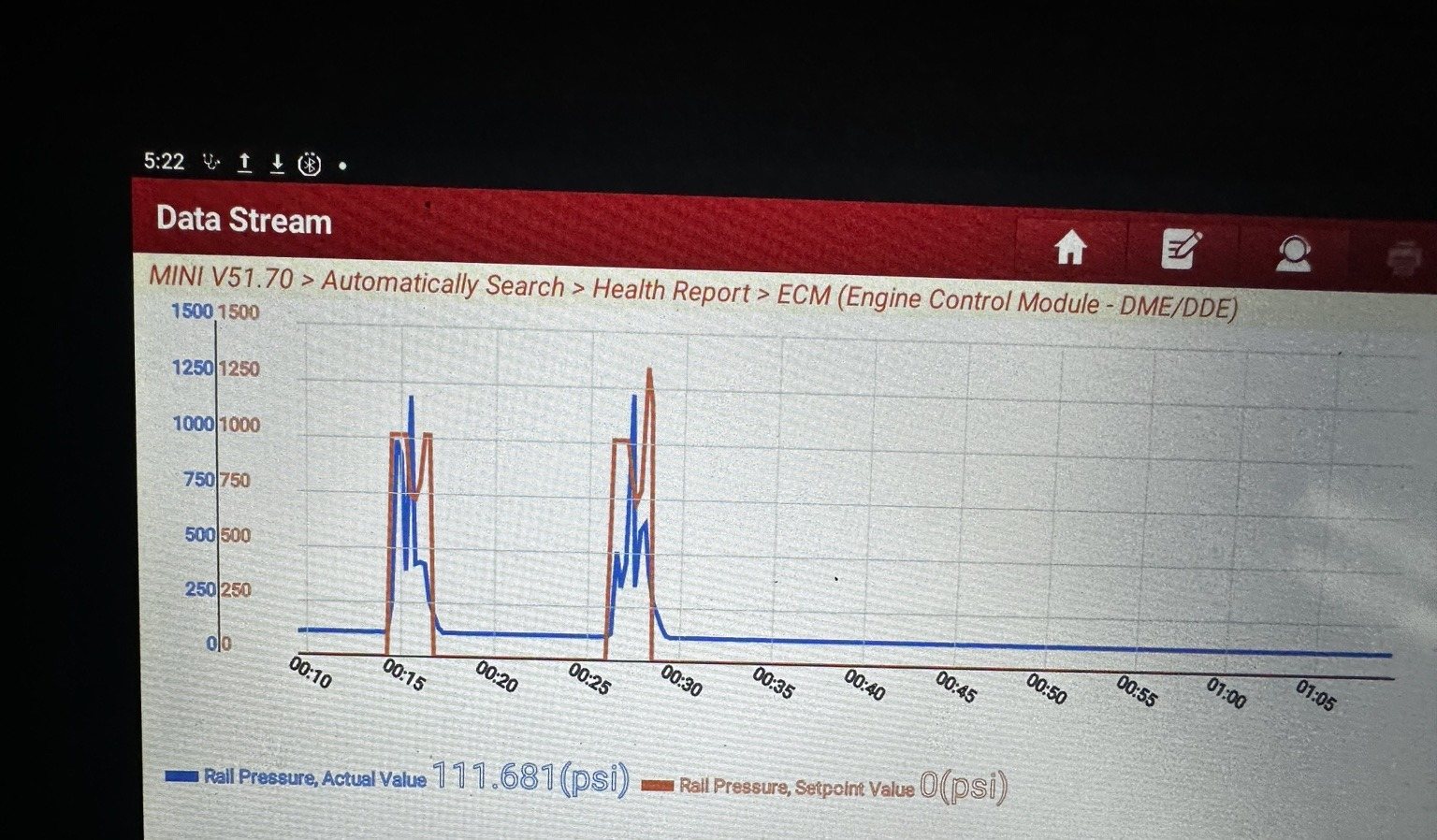
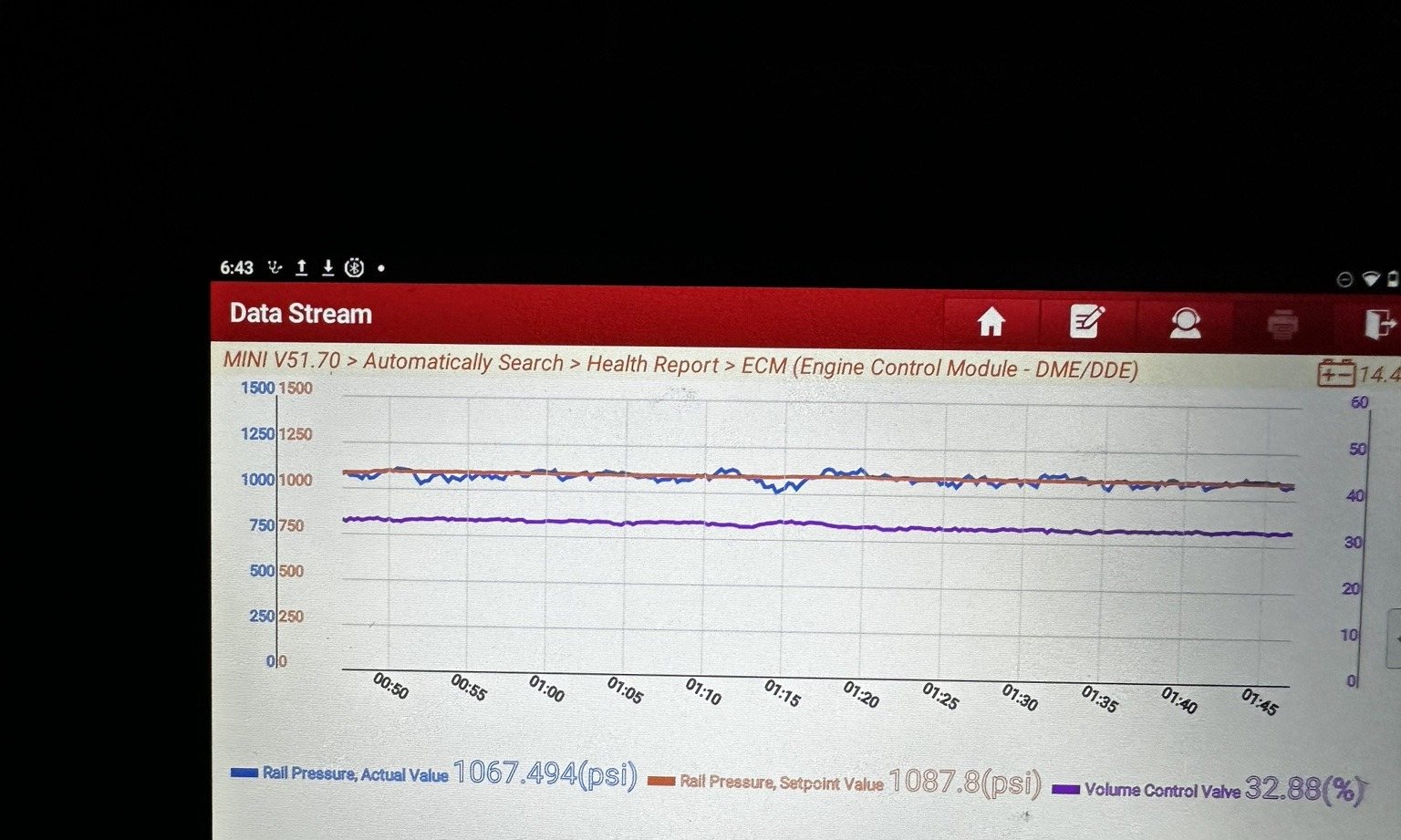
A 2010 MINI Cooper S came in as a crank/no-start after a few days of running rich, and the high pressure fuel pump was the immediate suspect — it usually is on an N14. Rather than order the pump, the fuel system was proven with live data. The low pressure side held around 100 psi with the ignition on. During start attempts the actual rail pressure followed the DME's commanded pressure straight past 1,000 psi. At idle it settled at 1,067 psi against a 1,088 psi setpoint, with the volume control valve steady near 33 percent. Fuel delivery control adaptation read 0.99, the pressure did not collapse under acceleration, and the engine restarted within about a second hot or cold. Every measurable indicator said the pump was healthy, so it stayed on the car and the diagnosis moved to the electrical and DME side. The wider repair on this vehicle is written up separately as a crankshaft sensor circuit and DME fault; this case study is the part that kept an expensive pump from being replaced for nothing.
- Vehicle
- 2010 MINI Cooper S (R56, N14 1.6L Turbo)
- Difficulty
- ★★★★☆
- Repair Time
- 8 hours
- Outcome
- High pressure fuel pump proven healthy on live data and left on the car; the no-start was traced elsewhere
Vehicle Information
| Year | 2010 |
|---|---|
| Model | Cooper S |
| Chassis | R56 |
| Engine | N14 1.6L Turbo |
| Transmission | 6-speed manual |
| Mileage | 131150 |
Repair Timeline
- July 2026 Complaint Car towed in as a crank/no-start after several days of running rich. The owner suspected the high pressure fuel pump, which is the usual first guess on an N14.
- Week 1 Diagnosis Low pressure supply measured with the key on — around 100 psi, stable, and roughly 84 psi with the engine off.
- Week 1 Diagnosis Rail pressure actual and setpoint logged during start attempts. Actual pressure followed the commanded value past 1,000 psi on each crank.
- Week 2 Diagnosis Rail pressure logged at idle — 1,067 psi actual against a 1,088 psi setpoint, with the volume control valve steady near 33 percent.
- Week 2 Diagnosis Fuel delivery control adaptation read at 0.99, and rail pressure held during acceleration up to the 5,000 RPM ceiling the car had for unrelated reasons.
- Week 2 Verification Hot and cold restarts repeated, each firing within about a second, and a 20 minute road test completed with no stall, no reduced power event and no active DME faults.
- Week 2 Repair High pressure fuel pump left on the car. Diagnosis redirected to the electrical and DME side.
Customer Complaint
The car cranked but would not start. For several days before the no-start the owner had noticed it running rich. The high pressure fuel pump had already been raised as the likely cause, because N14 pump failures are well known.
Symptoms
- Engine cranks but does not start
- Reported rich running in the days before the no-start
- No fuel-system fault codes stored
- No hot restart complaint — the symptom most associated with a failing HPFP was absent
Diagnostic Process
Start at the low pressure side, because it is the cheaper half to prove. The N14 carries two pumps: an in-tank low pressure pump feeding a camshaft-driven high pressure pump that supplies the direct injection rail. If the in-tank pump is weak, the high pressure pump is starved and looks guilty. Measured here: about 84 psi engine off, about 100 psi with the ignition on, and stable. Supply was not the problem.
Log rail pressure actual against setpoint, not rail pressure alone. A single pressure number means very little without knowing what the DME asked for. Graphed side by side during two start attempts, the commanded value stepped up and the actual value chased it past 1,000 psi both times before falling back to low-pressure supply once the attempt ended. A pump that cannot build pressure produces a flat actual trace under a rising setpoint. This one did the opposite.
Repeat it at idle with the volume control valve in the picture. Once running, actual pressure sat at 1,067 psi against a 1,088 psi setpoint — roughly 75 bar — and the volume control valve held steady around 33 percent. That third trace is the one that closes the argument: the DME was metering the pump back to a third of its capacity to hold the target. A pump on its way out forces the valve to command more, not less, and the actual trace hunts around the setpoint instead of shadowing it.
Read the adaptation before deciding the pump is fine. Fuel delivery control adaptation was 0.99. That is the DME saying it has not needed to compensate for delivery. Adaptation is the long-memory version of the live graph — it catches a pump that is slowly weakening even when the snapshot on the screen looks acceptable.
Load it. Rail pressure was watched through repeated acceleration runs. It stayed with the commanded value throughout and did not collapse. The engine hit a hard 5,000 RPM ceiling that belonged to another, unrelated problem on this car — the important part being that fuel pressure was intact at the ceiling, so it was not the fuel system imposing it.
Test the symptom you were told about, and the one you were not. Poor hot restart is the classic HPFP complaint. Restarts were performed repeatedly, cold and hot, and the engine fired within about a second every time. Oxygen sensor data and fuel trims were within range at idle with no rich condition present, which also failed to reproduce the original complaint from the fuel side.
Repair Performed
No fuel system parts were replaced. The high pressure fuel pump, the low pressure pump and the rail sensor were all left on the car, and the diagnostic effort was redirected to the electrical and DME side, where the fault actually lay.
Verification
- Low pressure supply approximately 100 psi with ignition on, stable
- Rail pressure actual value tracked setpoint during cranking, exceeding 1,000 psi
- Idle rail pressure 1,067 psi actual against 1,088 psi setpoint, approximately 75 bar
- Volume control valve steady near 33 percent at idle
- Fuel delivery control adaptation 0.99
- No rail pressure collapse through repeated acceleration runs
- Hot and cold restarts within approximately one second, repeated
- Approximately 20 minute road test with no stalling, no reduced power warning and no active DME faults
Technician Notes
The strongest evidence in this whole case is the pair of traces, not any single reading. Actual pressure alone tells you what the rail is doing; actual against setpoint tells you whether the pump is keeping the promise the DME asked it to keep. On the cranking capture the two move together. On the idle capture they are within about 20 psi of each other with a third trace, the volume control valve, sitting calmly at a third of travel. There is no version of a failing pump that produces those three lines.
Reputation is not diagnosis. The N14 pump fails often enough that "it's the HPFP" is a reasonable opening hypothesis, and that is exactly what makes it dangerous — it is expensive enough to matter and plausible enough to go unchallenged. The customer had already reached that conclusion before the car arrived.
Adaptation is worth reading even when the live data looks good, because the two answer different questions. The graph is now; the adaptation is the last few thousand miles. A pump that is fine on a warm shop floor and marginal on a hot day usually shows up in the adaptation first.
Rich running before a no-start pulls attention toward fuel delivery, but a pump that is failing makes an engine lean, not rich. That inconsistency was in the complaint from the beginning and it is the sort of thing worth noticing before spending an afternoon proving the fuel system.
The 5,000 RPM ceiling is a good example of separating findings from the finding. It was real and it was a problem, but rail pressure was solid at that point, so it belonged to a different investigation.
Lessons Learned
- Prove the low pressure side first. It is quicker and cheaper than condemning the pump it feeds, and a starved high pressure pump imitates a failed one.
- Always graph rail pressure actual against setpoint. A pressure reading without the commanded value beside it does not tell you whether the pump is keeping up.
- Watch the volume control valve. A healthy pump gets metered back; a tired one gets commanded harder to hold the same pressure.
- Read fuel delivery control adaptation. Near 1.0 means the DME has not been compensating, which is evidence a snapshot cannot give you.
- Deliberately test hot restart rather than waiting to be told about it. Its absence is real evidence against an HPFP failure.
- Rich running points away from a failing high pressure pump, not toward it.
- Baselines worth keeping for the N14: approximately 100 psi low pressure with ignition on, approximately 75 bar (1,090 psi) rail pressure at idle, adaptation approximately 1.0, and pressure that tracks demand under throttle.
Final Outcome
The high pressure fuel pump was proven healthy and stayed on the car. Low pressure supply, rail pressure during cranking and at idle, volume control valve position, fuel delivery adaptation, behaviour under load and repeated hot and cold restarts all pointed the same way. Eliminating the fuel system on data rather than reputation moved the diagnosis onto the electrical and DME side, where the actual fault was found, and saved the owner the cost of a pump that was working correctly.
Photos From This Repair
Questions About This Repair
What should rail pressure be on a MINI Cooper S N14 at idle?
On this car the actual rail pressure sat at about 1,067 psi against a commanded 1,088 psi at idle — roughly 75 bar — with the volume control valve holding near 33 percent. The number that matters more than the absolute value is the gap between actual and setpoint. Actual tracking setpoint within a few percent, without hunting, is a pump doing its job.
What is normal low pressure fuel pump pressure on an N14?
This car measured about 84 psi with the engine off and around 100 psi with the ignition on, and it held there. The in-tank pump only has to keep the high pressure pump supplied, so what you are looking for is a stable figure that does not sag while the engine draws fuel.
What does fuel delivery control adaptation tell you?
It is the DME's record of how much it has had to compensate to get the fuel delivery it asks for. This car read 0.99, essentially no correction. A pump that is losing capacity generally drags that value away from 1.0 over time, so a near-perfect adaptation is evidence the fuel system has not been quietly deteriorating.
Does a hard hot restart always mean the high pressure fuel pump is failing?
It is one of the classic symptoms, so it is worth testing deliberately rather than waiting for the customer to report it. This car was restarted hot and cold repeatedly and fired within about a second every time, which is a poor fit for a failing pump.
Why is the N14 high pressure fuel pump replaced so often?
Because it has a genuine reputation for failure, so it becomes the default suspect for anything fuel-adjacent. The reputation is earned, but it also means pumps get replaced on symptoms alone. Live data settles it before an expensive part is ordered.
Can the fuel system be ruled out as the cause of a no-start?
Not on its own, but it can be ruled out as a cause. Once you have shown supply pressure is stable, commanded rail pressure is achieved during cranking, adaptation is neutral and the pressure does not collapse under load, a fuel delivery failure no longer explains the complaint and the search moves on.
Repairs Like This One
- 8 documented Diagnosis repairs. See them all →
- 7 documented Engine repairs. See them all →