MINI Cooper Key Programming: CAS3 Key Add on a 2012 Cooper S
Quick Summary
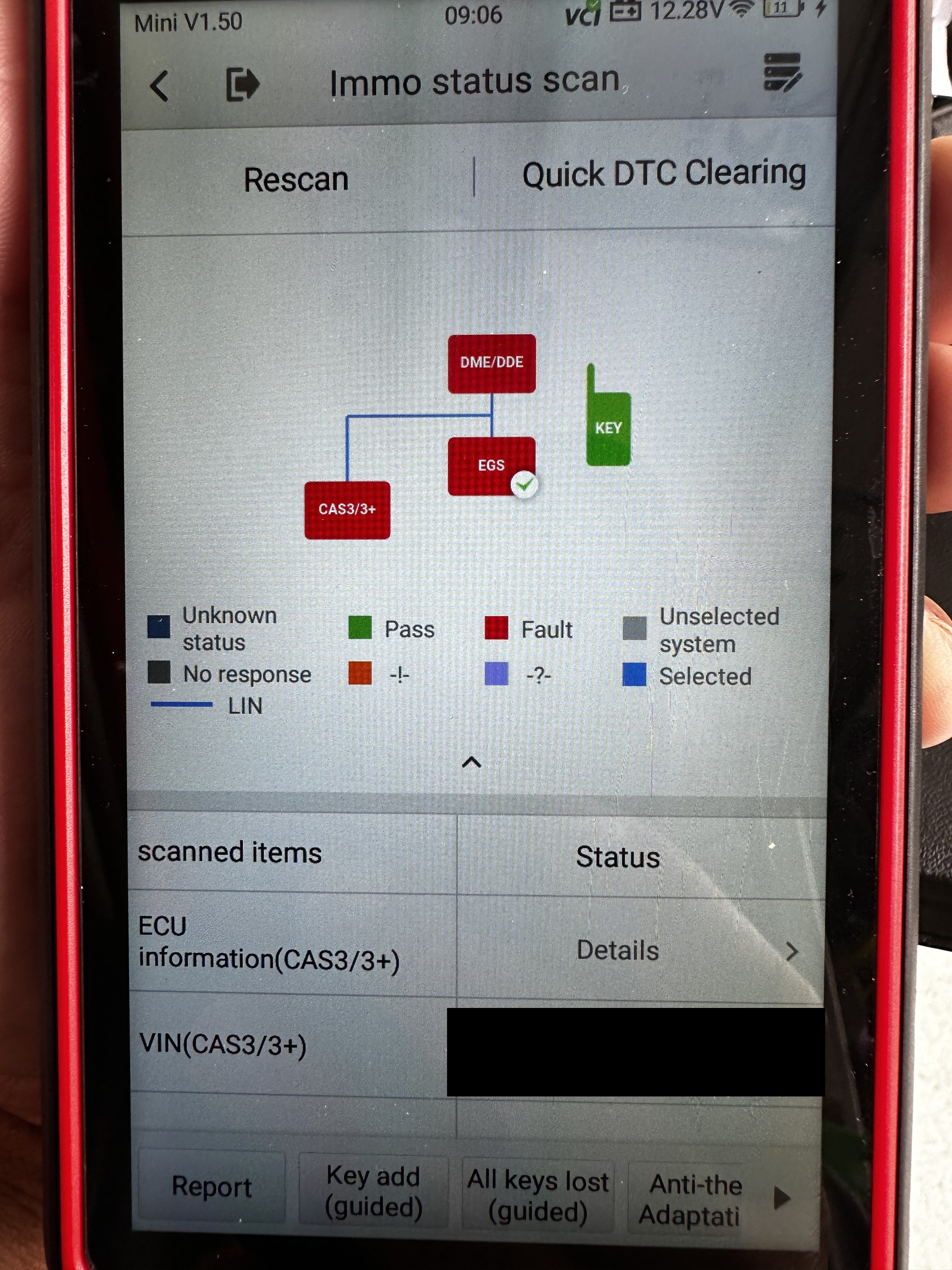
A 2012 MINI Cooper S was already in the shop for its 100,000-mile service when the owner produced two key fobs she had bought and asked whether both could be programmed. On second-generation MINIs key work is Car Access System work: the CAS holds the immobiliser identity, the numbered key slots and the cryptographic data a key has to carry, so the first step was an immobiliser status scan rather than anything to do with the fobs. It came back CAS3/3+, read the VIN out of the module, showed the inserted key recognised and offered guided key add, all keys lost and anti-theft adaptation. The car still had its original CAS, a working key was present and at least two slots were free, so the whole job ran through the OBD port: read the CAS immobiliser data, assign a free slot to each fob, personalise each transponder to its slot and write the modified CAS data back. Both fobs were accepted, and each was verified on its own — engine started on that key alone, with lock, unlock and trunk release working from its buttons. The bench route — connecting the programmer directly to the CAS and reading its EEPROM and processor data — is reserved for encrypted CAS3+ versions, all-keys-lost work and cars carrying a replacement CAS, and it is the version of this job that can leave a car that will not start.
- Vehicle
- 2012 MINI Cooper S (R56, N18 1.6L Turbo)
- Difficulty
- ★★★★☆
- Repair Time
- Same visit as the 100,000-mile service
- Outcome
- Both customer-supplied fobs programmed through the OBD port into free CAS key slots; each verified to start the car and operate lock, unlock and trunk
Vehicle Information
| Year | 2012 |
|---|---|
| Model | Cooper S |
| Chassis | R56 |
| Engine | N18 1.6L Turbo |
| Transmission | 6-speed manual |
| Mileage | 100000 |
Repair Timeline
- August 2026 Complaint While the 2012 Cooper S was in for its 100,000-mile service, the owner brought in two key fobs she had bought and asked for both to be programmed to the car.
- August 2026 Diagnosis Immobiliser status scan run before anything else. The tool identified the car's Car Access System as CAS3/3+ and read the VIN from it, with the inserted key recognised and the guided key add, all keys lost and anti-theft adaptation routines available.
- August 2026 Diagnosis CAS key slots read and reviewed. The car had its original CAS, a working key was present and at least two slots were free, which makes this an additional-key job through the OBD port rather than a bench read.
- August 2026 Repair Both fobs programmed through the OBD port — CAS immobiliser data read, a free slot assigned to each fob, each transponder personalised to its slot and the modified CAS data written back.
- August 2026 Verification Each new key verified individually — started the engine on that key alone, and lock, unlock and trunk release confirmed working from its buttons.
Customer Complaint
The car came in for a scheduled 100,000-mile service with no driveability complaint. While it was in, the owner handed over two key fobs she had bought herself and asked for both to be programmed to the car.
Symptoms
- No driveability complaint; the car was in for scheduled maintenance
- Two customer-supplied key fobs, neither recognised by the car
- Existing working key present and recognised by the immobiliser scan
- At least two unused key slots in the car's original CAS
Diagnostic Process
Scan the immobiliser before you touch a key. The immobiliser status scan is what tells you which Car Access System the car actually has, whether it will talk, and what the tool is prepared to do with it. On this car it came back as a CAS3/3+ and read the VIN straight out of the module. That single screen decides the rest of the job. CAS2, CAS3, CAS3+ and the encrypted CAS3+ software versions are not the same job: the earlier ones can generally be handled through the diagnostic connector, while an encrypted CAS3+ can force the data to be read more directly.
Confirm the key that already works is seen. The scan showed the inserted key recognised. That separates an additional-key job from an all-keys-lost recovery, and the difference is material. With a working key the tool can use it to authenticate and read what it needs. With no key at all the information has to be derived from the CAS data itself, and on encrypted CAS3+ versions that can pull in extra calculation, a direct CAS read or the DME's ISN.
Read the slot list before writing anything. The CAS keeps numbered key positions and records each as an existing working key, a used slot, an available slot, or a disabled or lost one. That list is the plan: an added key goes into an unused slot, and on a lost-key job the lost slot gets disabled so that key can no longer authorise a start. Worth knowing at the counter — disabling a slot does not stop the mechanical blade opening the door, and remote locking is not the same function as start authorisation.
Know the topology you are looking at. The scan lists DME/DDE, EGS and CAS3/3+ as the immobiliser-relevant modules. This car is a 6-speed manual, so there is no EGS in it to answer a scan — a red EGS box on a manual car is not a transmission fault to go chasing.
Judge the keys themselves. A new, unlocked key is the one you want. A used CAS3 MINI key is normally already cryptographically locked to the car it came from, and putting it in the programmer does not undo that; it needs a supported unlock, a new transponder IC, a new key board or a fresh blank. Changing the shell or the blade changes nothing about the immobiliser identity.
Repair Performed
- Immobiliser status scan to identify the CAS generation and confirm communication
- CAS immobiliser data read through the OBD port — the car has its original CAS and a working key, which is the normal path on a second-generation MINI
- Key slot list reviewed and a free slot assigned to each fob
- Each transponder personalised from the CAS data for its slot: key identity, vehicle and CAS authentication data, encrypted synchronisation data and the configuration for this key type
- Modified CAS data written back to activate and configure the two slots
- Both fobs programmed and returned to the owner
The same job on a car that does not qualify for the OBD route runs on the bench instead: read the CAS directly, calculate the key, program the blank, modify the CAS file, write it back, refit and test.
Parts Used
- Aftermarket Key Fob Customer Supplied
Verification
- CAS3/3+ identified and communicating; VIN read from the module
- Existing key shown as recognised by the immobiliser scan before any programming
- Free key slots confirmed in the CAS slot list before a key was generated
- System voltage at 12.28 V during the scan
- Each new key started the engine on that key alone
- Lock, unlock and trunk release confirmed working from each new key's buttons
- Both programmed fobs returned to the owner with the car
Technician Notes
Customers hear "programming a key" and picture the fob being taught to the car. It is closer to the other way round: the tool reads the CAS's secure key information, assigns an available slot, and generates a transponder for that slot. The key is manufactured from the car's data, not copied from the old key. That framing is also what explains the price — you are working inside the module that authorises starting the engine.
The immobiliser status scan is cheap and it is the whole plan. CAS version tells you which method applies, whether the module answers tells you if this is an OBD job or a bench job, and whether the current key is recognised tells you whether you are adding a key or recovering from all keys lost. Skipping it to save five minutes is how a key job turns into a car that does not start.
Most Gen-2 key adds never need the module out of the car. It is worth saying because the bench route gets all the attention: soldering to the CAS, reading EEPROM and processor data, writing modified data back. That is the exception — encrypted CAS3+, all keys lost, or a CAS that is not the car's original — and it is where the risk lives. A failed or corrupted CAS write can leave no key recognition, a dead dash, a CAS that will not communicate, CAS-to-DME synchronisation problems, or a crank-no-start. A stable power supply and a verified backup of every original read are not optional on that path.
Customer-supplied fobs are the variable nobody controls, and the failure is almost always the part rather than the procedure — wrong key type for the CAS, or a used key still locked to another car. Both of these were right and both went in. It is still worth saying before the work starts that the labour buys the attempt.
The immobiliser half and the remote half of a key are related but not identical. A freshly programmed key can start the car while the buttons still need initialising, or work the locks while the transponder is not authorised to start. That is why both new keys were checked both ways — engine start on that key alone, then lock, unlock and trunk — rather than accepting a successful start as proof the key was finished.
A key add does not touch the DME. The authorisation chain runs key transponder to CAS, CAS to terminal and start request, then CAS and DME confirming they match, then the DME allowing fuel and spark. Adding a key inserts something the existing CAS accepts; it relies on the CAS and DME already being correctly matched. The ISN only becomes the problem when that relationship is broken — a replacement CAS, or an all-keys-lost job on an encrypted version where the ISN has to come from the DME.
The red EGS box on this scan is a good example of reading the tool rather than reacting to it. The car is a manual. There is no EGS module in it to respond, so that node showing unhappy is the expected result, not a finding.
Lessons Learned
- Key work on a second-generation MINI is CAS work. The key is generated from the CAS's data for a specific slot, not taught to the car.
- Run the immobiliser status scan first. It identifies the CAS version, proves communication and tells you whether the job is an additional key or an all-keys-lost recovery.
- Most Gen-2 key adds are done through the OBD port. Keep the bench read for encrypted CAS3+, all keys lost, and cars carrying a replacement CAS.
- Read the slot list before generating anything, and use it to disable the slot of a key that has been lost.
- A VIN is not a key. Without the cryptographic data from that specific CAS, a correctly cut key opens the door and nothing else.
- Buy new, unlocked keys. A used CAS3 key is locked to its original car, and a new shell or blade does not change that.
- Test the immobiliser and the remote separately at handover. One working does not prove the other.
- Back up every CAS read and keep a stable supply on the car before any write. A corrupted CAS write is a no-start, not a retry.
Final Outcome
Both fobs the owner supplied were accepted, programmed into free slots in the car's original CAS through the OBD port, and handed back to her with the car at the end of its 100,000-mile service. Each was verified on its own: it started the engine, and lock, unlock and trunk release worked from its buttons. Nothing had to come out of the car and the DME was untouched — the car's own CAS generated two more keys it recognises.
Photos From This Repair
Questions About This Repair
Can a customer-supplied key fob be programmed to a second-generation MINI Cooper?
Yes, provided it is the right key type for that car's Car Access System and the transponder is a new, unlocked one. Both fobs the owner of this 2012 Cooper S supplied were accepted, programmed into free CAS key slots, and verified to start the car and work the locks and trunk. A used key from another MINI is a different matter — it is normally already locked to the car it came from.
Does programming a MINI key need the car, or can it be done off the car?
The immobiliser data has to come from the car's CAS. Most of the time on a second-generation MINI that read happens through the OBD port with the car in front of you. Encrypted CAS3+ versions and all-keys-lost jobs are the cases that push the work onto the bench, reading the CAS directly.
What is a CAS key slot?
The Car Access System keeps numbered key positions and records whether each is used, available, disabled or lost. A new key is generated for one specific slot, which is why an added key is tied to the CAS data it came from and why the tool shows the slot list before anything is written.
Can a lost MINI key be disabled?
The slot belonging to a lost key can normally be disabled so that key can no longer authorise an engine start. That is not the same as making the key useless — the mechanical blade will still open the door, and remote locking behaves separately from start authorisation.
Why will a key cut to the VIN not start a MINI?
Because the immobiliser does not authenticate on the VIN. The transponder has to carry cryptographic data generated from that specific CAS, for a specific slot in it. A blade cut from the VIN opens the door; it does not get the DME to deliver fuel and spark.
Does programming a key change the DME?
No. Adding a key produces a key the existing CAS accepts. The CAS and the DME still have to be correctly matched to each other, and the ISN that ties them together is untouched by a key add — it only comes into play when the CAS itself has been replaced or all keys are lost on an encrypted version.
Repairs Like This One
- 11 documented Electrical repairs. See them all →
- 5 documented Programming repairs. See them all →