2016 MINI Countryman ALL4 Power Loss Reveals a Drain-Plug Oil Leak
Quick Summary
A 2016 MINI Countryman S ALL4 was booked as a mobile visit for an intermittent loss of power. During the road test the engine oil-pressure warning was seen blinking, and that finding took priority over the complaint that brought the car in. The oil level was significantly low. Rather than topping it off, the underside of the car was inspected and an active leak was found at the engine oil drain plug, following an oil service at an outside quick-service facility about a month earlier. The oil was drained, the incorrect drain-plug and sealing arrangement was replaced with the correct parts and the engine was refilled. Diagnosis then returned to the original complaint: a scan recorded 2C57 as history and 2C91 as current in the engine module, directing the next stage toward the turbocharger cut-off (diverter) valve. A Pierburg replacement valve with O-ring was ordered for a follow-up appointment, so the power-loss concern is documented as unresolved rather than repaired.
- Vehicle
- 2016 MINI Countryman S (R60, N18 1.6L Turbo)
- Difficulty
- ★★★☆☆
- Repair Time
- Not documented hours
- Outcome
- Oil leak at an incorrectly installed drain plug found and corrected during a power-loss diagnosis; the remaining boost fault was traced toward the turbocharger cut-off valve and a replacement was ordered for a follow-up visit
Fault Codes
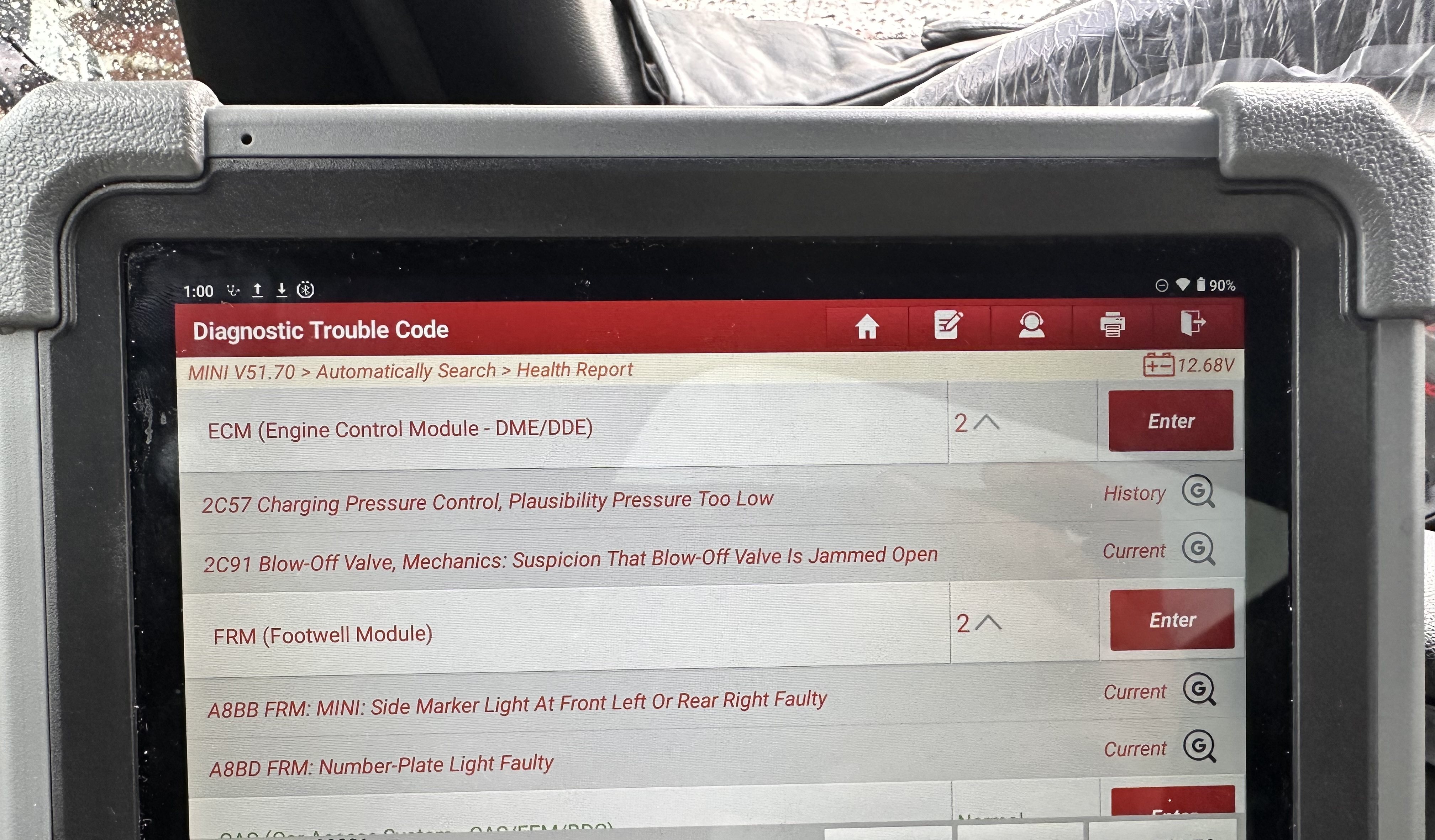
A8BD — Number-Plate Light Faulty2C57 Charging Pressure Control, Plausibility Pressure Too Low2C91 Blow-Off Valve, Mechanics: Suspicion That Blow-Off Valve Is Jammed OpenA8BB Side Marker Light At Front Left Or Rear Right Faulty
Vehicle Information
| Year | 2016 |
|---|---|
| Model | Countryman S |
| Chassis | R60 |
| Engine | N18 1.6L Turbo |
| Transmission | Not documented |
| Mileage | 116989 |
Repair Timeline
- Initial contact Complaint Owner reports that the 2016 Countryman S ALL4 sometimes loses power. The concern sounds like a short diagnostic job, so a mobile visit is scheduled.
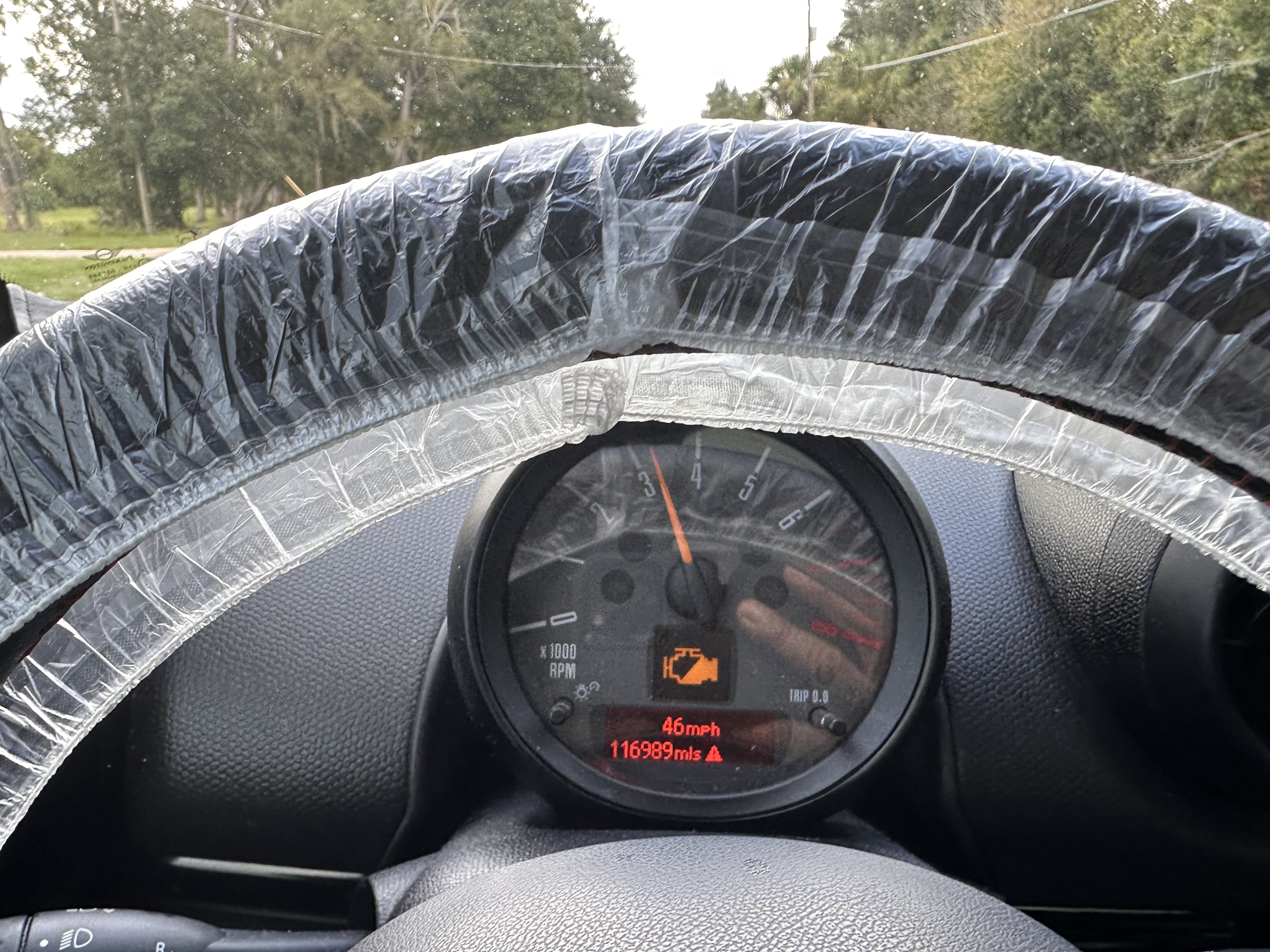
- Road test Diagnosis The owner drives the car so the intermittent complaint can be duplicated. During the drive the engine oil-pressure warning is seen blinking, which outranks the power-loss complaint.
- After road test Diagnosis Engine oil level is checked and found significantly low. The owner is asked to obtain approximately three quarts of the correct oil.
- While adding oil Diagnosis The underside of the car is inspected rather than simply topping the level off. An active leak is found at the engine oil drain plug, and the owner discloses an oil service at a nationwide quick-service facility about a month earlier.
- Same visit Repair The oil is drained, the incorrect drain-plug and sealing arrangement is replaced with the correct plug and seal for the MINI application, and the engine is refilled to the correct level.
- After the oil repair Verification The car is driven again and scanned. The engine module holds 2C57 as history and 2C91 as current; the footwell module reports A8BB and A8BD.
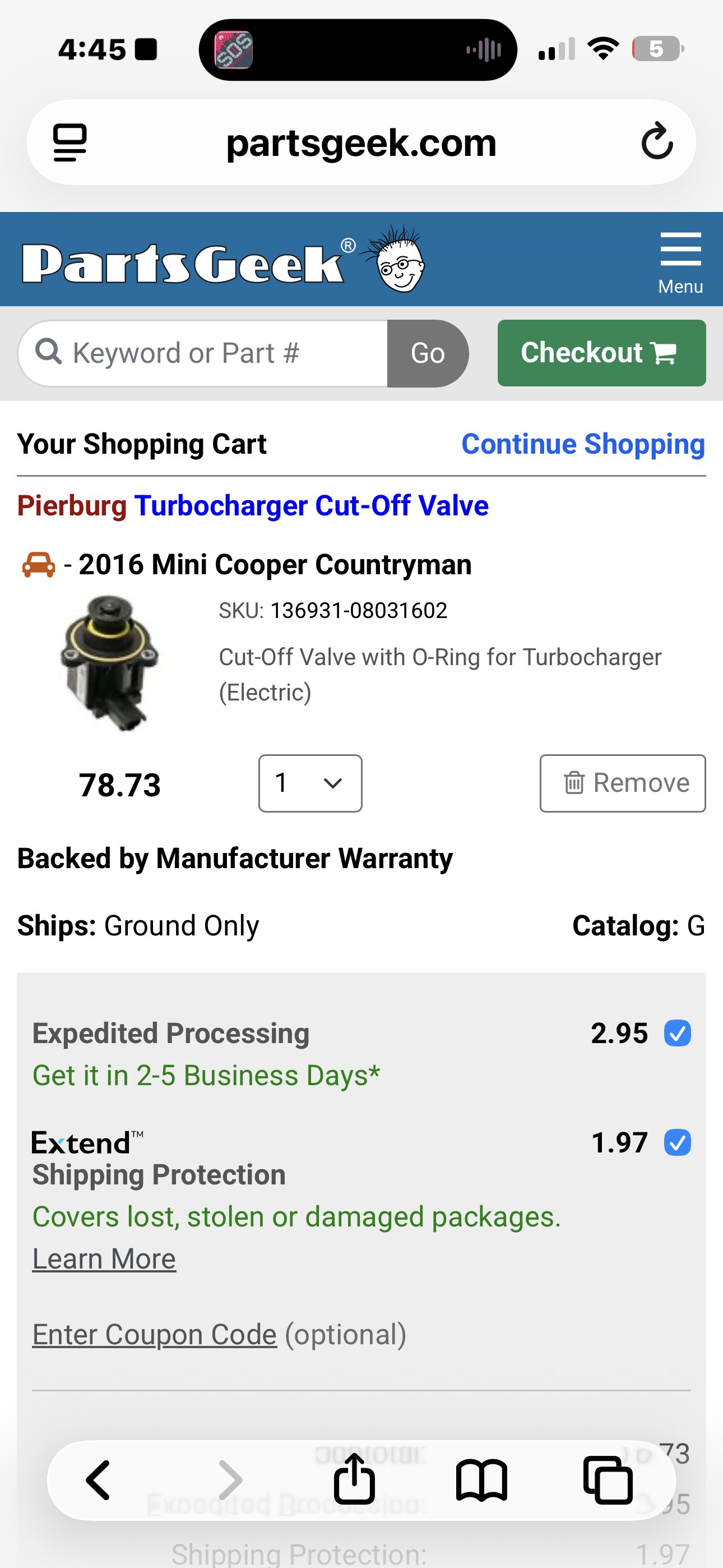
- Repair plan Repair 2C91 directs diagnosis to the turbocharger cut-off (diverter) valve. A Pierburg cut-off valve with O-ring is ordered and a follow-up appointment is planned; the valve was not fitted during the mobile visit.
Customer Complaint
The owner reported that the car would sometimes lose power. Because that description sounded like it might be a short diagnostic job or a minor repair, the visit was handled as a mobile service call rather than a shop appointment. The owner then drove the vehicle on a short test drive so the intermittent condition could be duplicated with the technician in the car.
Symptoms
- Intermittent loss of power reported by the owner
- Engine oil-pressure warning observed blinking during the road test
- Check-engine light illuminated at road speed, with 116,989 miles displayed
- Engine oil level significantly low on inspection
- Fresh oil visible on the pavement under the vehicle
- Active oil leak at the engine oil drain plug
- Post-repair scan: 2C57 stored as history, 2C91 current, A8BB and A8BD current in the footwell module
Diagnostic Process
Duplicate the complaint before diagnosing it. An intermittent power loss is not something to diagnose from a description. The owner drove the car so the condition could be observed rather than reconstructed, which also put the instrument cluster in front of the technician while the engine was under load.
Let the car reset the priority. The road test produced something the complaint had not predicted: the engine oil-pressure warning blinking intermittently. That is not the same warning as a low-level reminder. A genuine loss of oil pressure can destroy an engine, so the power-loss investigation was set aside until the lubrication question was answered.
Check the level, then ask where the oil went. The oil level was significantly low, and the owner was asked to obtain roughly three quarts of the correct oil so it could be restored. Adding oil answers the quantity question and nothing else. While filling, the underside of the car was inspected and an active leak was found at the engine oil drain plug, with fresh oil on the ground beneath it.
Take the recent service history seriously. The owner said the oil had been changed about a month earlier at a nationwide quick-service facility. Inspection showed the drain plug and sealing arrangement fitted at that service were not correct for this application, and oil was escaping past them. A recent oil change is not evidence that the drain plug, seal, level or filter are right; here it was the reason to look.
Come back to the original complaint with a scan, not an assumption. After the oil repair the car was driven again and scanned. The engine module held 2C57 (charging pressure control, plausibility pressure too low) as history and 2C91 (blow-off valve, suspicion that the valve is jammed open) as current. 2C91 is the code that points at the turbocharger's electrically controlled cut-off valve, also called the diverter, recirculation or compressor bypass valve.
Do not let a full code list become a parts list. The same scan reported A8BB and A8BD, both footwell-module lighting faults, and showed the Car Access System and tyre-pressure modules as normal. The lighting codes are real findings and are recorded as such, but nothing in this diagnosis ties them to the drivability complaint. A scan can hold faults from several systems at once; only 2C57 and 2C91 belong to the boost story.
Reason about the valve before replacing it. Under load the turbocharger compresses intake air. When the throttle snaps shut, that pressure needs a controlled path to escape or recirculate, and the cut-off valve provides it. A valve that will not seal or operate correctly lets boost escape when the engine management system expects the charge side to stay pressurised, which can present as intermittent power loss, reduced boost, sluggish acceleration or inconsistent turbo response. That makes the valve a reasonable next step behind a current 2C91 — a direction, not a diagnosis.
Repair Performed
- Drained the engine oil
- Replaced the incorrect drain plug and sealing arrangement with the correct plug and seal for the MINI application
- Refilled the engine to the correct oil level
- Road tested the vehicle again after the oil repair
- Scanned all available modules and recorded the stored and current faults
- Ordered a Pierburg turbocharger cut-off valve with O-ring for a follow-up appointment
The cut-off valve was not fitted during this visit. No boost or oil-pressure measurements were recorded, and no torque specification is claimed for the drain plug.
Parts Used
- Engine Oil Drain Plug Replacement
- Engine Oil Replacement
- Turbocharger Cut-Off Valve Ordered
Verification
- Engine oil level restored and confirmed after the drain-plug repair
- Oil-pressure warning no longer present after the leak was corrected and the level restored
- Vehicle road tested again after the oil repair
- Full module scan performed after the road test, recording 2C57 as history and 2C91 as current
- Turbocharger cut-off valve replacement documented as outstanding, not as completed work
- Power-loss complaint left open pending the follow-up appointment
The owner was advised that the car could be driven while the valve was on order, on the condition that driving stops and the technician is contacted if the oil-pressure warning returns or if the car develops a severe loss of power, abnormal engine noise, smoke or another major warning.
Technician Notes
The most useful thing that happened on this job was noticing a warning nobody had mentioned. The appointment existed because of a power complaint, and it would have been easy to spend the whole visit chasing boost. A blinking oil-pressure lamp on a car that is already low on oil is a different class of problem, and it does not wait for the diagnosis to be convenient.
Topping the oil off would have hidden the actual fault. The level was low because oil was leaving the engine at the drain plug, and the plug was wrong because of work done elsewhere a month earlier. That is a repeatable pattern worth checking on any car that arrives low on oil shortly after a quick oil service.
It is also worth being careful about what the oil repair proves. Restoring the level and stopping the leak removed the warning, and there were no remaining indications of an active lubrication problem during this visit. That is not the same as having measured oil pressure. If that warning comes back, the answer is a pressure test, not more oil.
On the boost side, 2C91 is a suspicion code — the module's wording is that the blow-off valve may be jammed open — and 2C57 supports it by recording charge pressure that was implausibly low. That combination justifies ordering the valve. It does not justify telling the customer the car is fixed. Confirmation is a road test under the conditions that produced the complaint, followed by a rescan to see whether 2C91 comes back.
Lessons Learned
- Diagnose what the car reports, not only what the customer described. The complaint gets you into the car; the road test tells you what actually needs attention first.
- Rank findings by consequence. An intermittent power loss is a driveability problem; a possible loss of oil pressure is an engine-replacement problem.
- A low oil level is a question, not an answer. Look for where the oil went before reaching for the fill cap.
- Inspect the drain plug, seal and filter after any recent outside oil service. Recent work is a reason to check, not a reason to trust.
- Keep the language honest about oil warnings. Low level and low pressure are different faults with different consequences, and adding oil does not verify pressure.
- One visit can produce two unrelated faults. Document them separately unless there is evidence that connects them.
- A stored code is a direction. Ordering a part behind a current 2C91 is reasonable; declaring the complaint solved before the valve is fitted and the car rescanned is not.
Final Outcome
The immediate risk was removed during the mobile visit: the drain-plug leak was corrected with the proper plug and seal, the engine oil level was restored and the oil-pressure warning was no longer appearing. The original intermittent power-loss complaint remains open. A current 2C91 with 2C57 in history pointed diagnosis at the turbocharger cut-off valve, and a Pierburg replacement valve with O-ring was ordered for a follow-up appointment. Confirmation of that repair — codes cleared, a road test under the conditions that produced the complaint and a rescan to see whether 2C91 returns — belongs to that later visit and is not claimed here. The footwell-module lighting faults A8BB and A8BD were also recorded and remain separate items.
Customer Feedback
The owner drove the car for the road test and stayed with the diagnosis as it changed direction, then obtained the oil needed to restore the level so the leak repair could be completed the same visit. After the lubrication concern was explained, the owner agreed to have the cut-off valve ordered and to bring the car back for the follow-up appointment rather than have the mobile visit extended.
Photos From This Repair


Questions About This Repair
Why was the oil leak fixed before the power-loss complaint?
The power-loss complaint was intermittent and driveable. A blinking oil-pressure warning can mean the engine is not maintaining lubrication pressure, which can destroy an engine in minutes. The higher-risk finding was addressed first, then diagnosis returned to the original concern.
What caused the oil leak on this Countryman?
An incorrect drain plug and sealing arrangement had been installed at an outside oil service about a month earlier, and engine oil was escaping past it. The plug and seal were replaced with the correct parts for the MINI application and the engine was refilled.
Is a low oil level the same thing as low oil pressure?
No. A low level is a quantity problem; low pressure means the lubrication system may not be maintaining pressure. A low level can contribute to low pressure, but adding oil on its own does not prove that oil pressure is healthy.
What does the turbocharger cut-off valve do?
It gives compressed intake air a controlled path to escape or recirculate when the throttle closes. If it does not seal or operate correctly, boost can leak away when the engine expects the system to stay pressurised, which can feel like an intermittent loss of power.
Was the turbocharger valve confirmed as the cause of the power loss?
Not yet. Fault 2C91 was current and pointed at that valve, so a Pierburg cut-off valve with O-ring was ordered for a follow-up appointment. The cause is only confirmed once the valve is fitted, the codes are cleared and a road test and rescan show the complaint gone.
Were the two lighting faults related to the power loss?
There is no evidence that they were. A8BB and A8BD are footwell-module lighting faults recorded in the same scan. They are documented as separate findings rather than treated as causes of the drivability complaint.
Repairs Like This One
- 9 documented Diagnosis repairs. See them all →
- 8 documented Engine repairs. See them all →