2016 MINI Countryman ALL4 Poor Acceleration Traced to Clutch Slip
Quick Summary
A 2016 MINI Countryman S ALL4 with a six-speed manual arrived with a poor-acceleration complaint and a strong suspicion, from the owner, that the turbo or its diverter valve was at fault again. There was no Check Engine Light and no Reduced Engine Power warning. A full-vehicle scan before any parts were touched found three stored faults — DME 387F, FRM A8BD and IHKA 9C90 — none of which had anything to do with boost, fuelling, throttle or misfire. Live data backed that up: high-pressure fuel tracked its setpoint at about 1,023 psi, low-side pressure held at 102 psi, misfire counters read 0, 0, 1, 0 and smooth-running values sat near zero. The decisive test was the road test. In second gear with the clutch pedal fully up, engine speed climbed roughly 1,000 to 1,500 rpm under load while road speed did not follow, the engagement point was very high and a friction odour was present. Clutch slippage was confirmed under load. Transmission removal and physical inspection of the clutch assembly is recommended. The owner reports the clutch was replaced about 25,000 miles ago; no cause for the early slip is assigned until the parts are seen.
- Vehicle
- 2016 MINI Countryman S (R60, N18 1.6L Turbo)
- Difficulty
- ★★★☆☆
- Repair Time
- Not documented hours
- Outcome
- Poor-acceleration complaint that arrived as a suspected turbo or diverter-valve problem was traced on a loaded road test to clutch slippage; transmission removal and physical inspection of the clutch assembly recommended before any cause is assigned
Fault Codes
A8BD — Number-Plate Light Faulty387F — Power Management, Closed-Circuit Current Violation9C90 — IHKA Control-Unit Fault
Vehicle Information
| Year | 2016 |
|---|---|
| Model | Countryman S |
| Chassis | R60 |
| Engine | N18 1.6L Turbo |
| Transmission | 6-speed manual |
| Mileage | Not documented |
Repair Timeline
- Initial contact Complaint Owner reports that the 2016 Countryman S ALL4 accelerates poorly and struggles to reach and hold highway speed. A turbo diverter valve had been replaced previously, so the owner suspects the turbo system again.
- Arrival Diagnosis No Check Engine Light and no Reduced Engine Power warning present. A full-vehicle scan is run before any parts are considered. Stored faults are DME 387F, FRM A8BD and IHKA 9C90; none relate to boost, fuel pressure, throttle, VANOS or misfire.
- Live data Diagnosis High-pressure fuel actual tracks the DME setpoint at roughly 1,023 psi; low-side pressure holds at about 102 psi (7 bar). Misfire counters read 0, 0, 1, 0 and smooth-running values sit near zero. Air mass and manifold pressure are watched while revving in the bay but not treated as a boost test.
- Road test Diagnosis In second gear with the clutch fully released, engine speed climbs roughly 1,000 to 1,500 rpm under load while road speed does not rise to match. Clutch engagement point is very high and a friction-like odour is noted. Clutch slippage under load is confirmed.
- Recommendation Repair Transmission removal and physical inspection of the clutch disc, pressure plate, dual-mass flywheel, release bearing and hydraulics recommended. Owner reports the clutch was replaced roughly 25,000 miles ago; no cause is assigned until the parts are seen.
Customer Complaint
The owner reported that the car accelerated poorly and had trouble reaching highway speed and holding it once there. A turbocharger diverter valve had been replaced previously for a related concern, and the owner arrived expecting the turbo system to be the problem again — either the new valve, the turbo itself or something else on the boost side. There was no Check Engine Light and no Reduced Engine Power warning.
Symptoms
- Poor acceleration; difficulty reaching highway speed and maintaining it
- No Check Engine Light and no Reduced Engine Power warning at any point during the diagnosis
- Stored faults on the full-vehicle scan: DME 387F, FRM A8BD, IHKA 9C90
- No DME boost, fuel-pressure, throttle, VANOS or significant misfire fault stored
- High-pressure fuel actual tracking the setpoint at approximately 1,023 psi
- Low-side fuel pressure approximately 102 psi (about 7 bar)
- Misfire counters: cylinder 1 = 0, cylinder 2 = 0, cylinder 3 = 1, cylinder 4 = 0
- Smooth-running values for all four cylinders near zero
- Road test: engine rpm climbing roughly 1,000 to 1,500 rpm in second gear with the clutch fully released while vehicle speed did not increase to match
- Clutch engagement point very high in the pedal travel
- Friction or brake-like odour noticed during the diagnosis
Diagnostic Process
Scan the whole car before touching a part. The complaint arrived with a diagnosis attached — "it's the turbo again" — and a previous diverter-valve replacement that had not fixed it. That history is exactly why the first step was a complete scan of every module rather than another boost-side part. Three faults were stored.
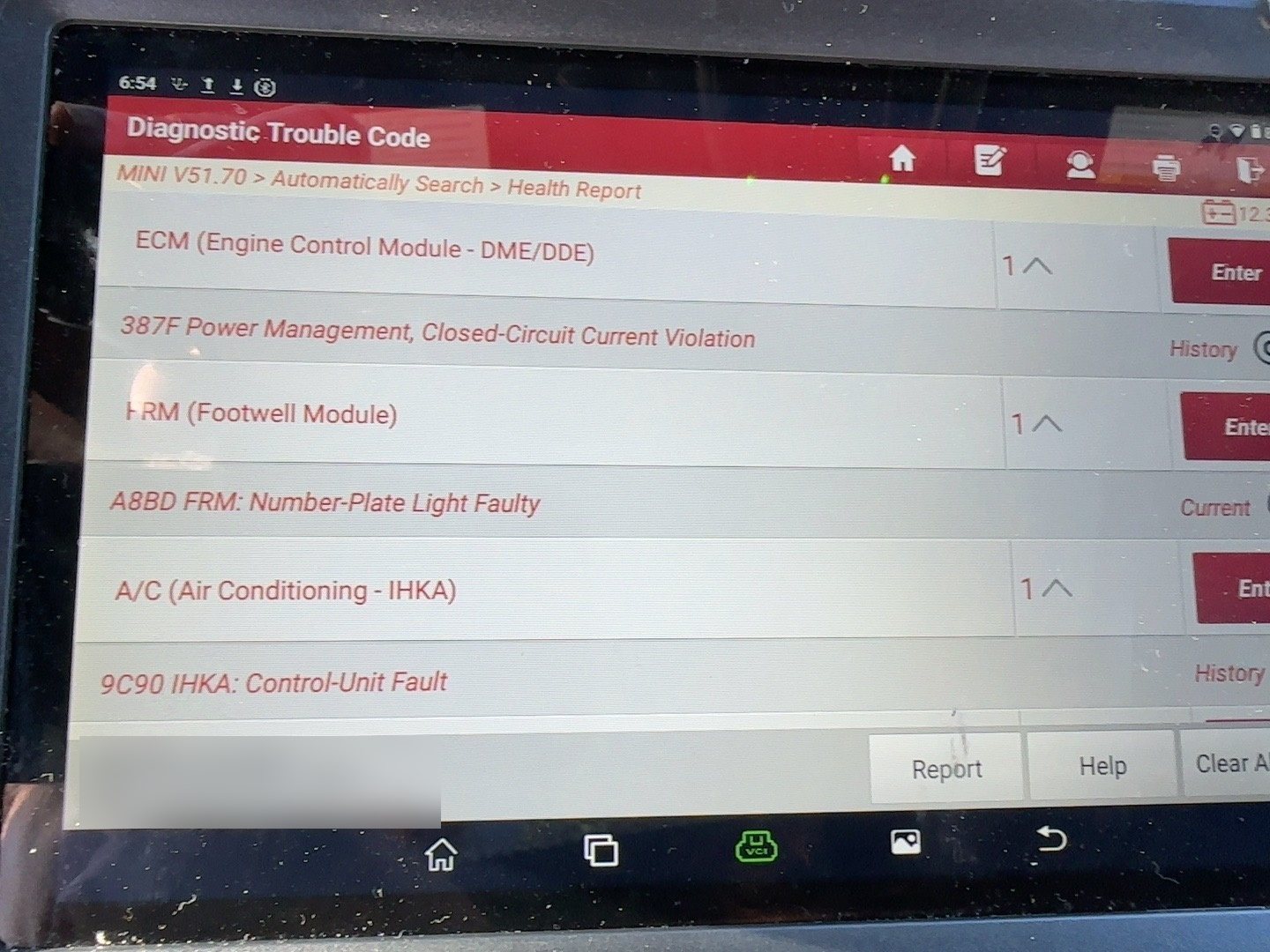
- 387F (DME) — Power Management, Closed-Circuit Current Violation. The engine module recorded that the car drew more current than allowed while switched off. That is a battery-drain finding, not a running-engine finding.
- A8BD (FRM) — Number-Plate Light Faulty. The footwell module sees an electrical fault in the licence-plate lamp circuit.
- 9C90 (IHKA) — Control-Unit Fault. An internal fault in the climate-control unit.
None of these can make the car accelerate poorly, and none of them is a boost, fuel-pressure, throttle, VANOS or misfire code. They are recorded here as separate findings.
Remember what a clean engine scan does and does not prove. The absence of a boost or fuelling code does not certify every engine component as good. The DME only stores a fault when a monitored value leaves a window it is programmed to watch. So rather than stopping at "no engine codes", the live data the DME does have was checked against the complaint.
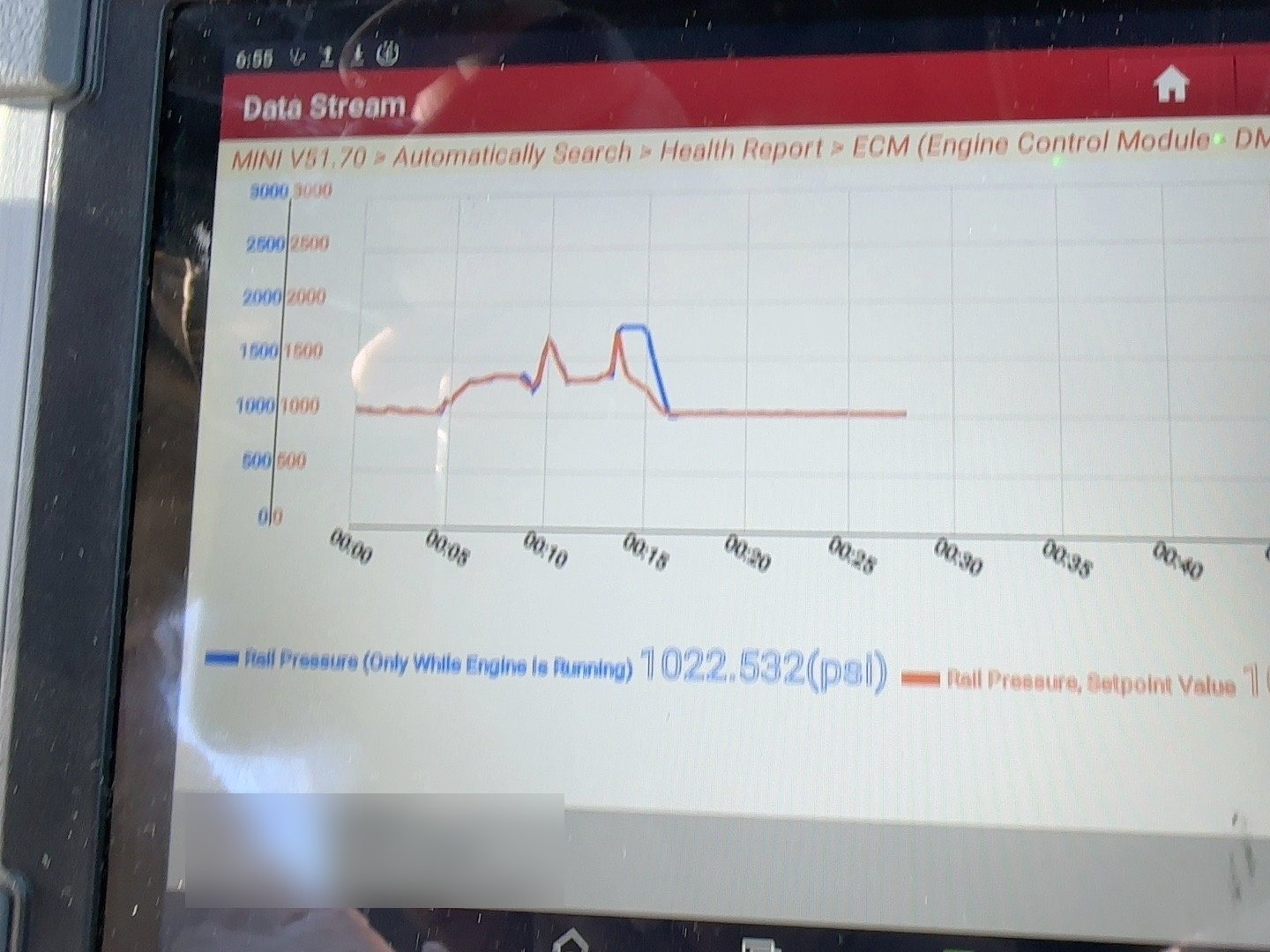
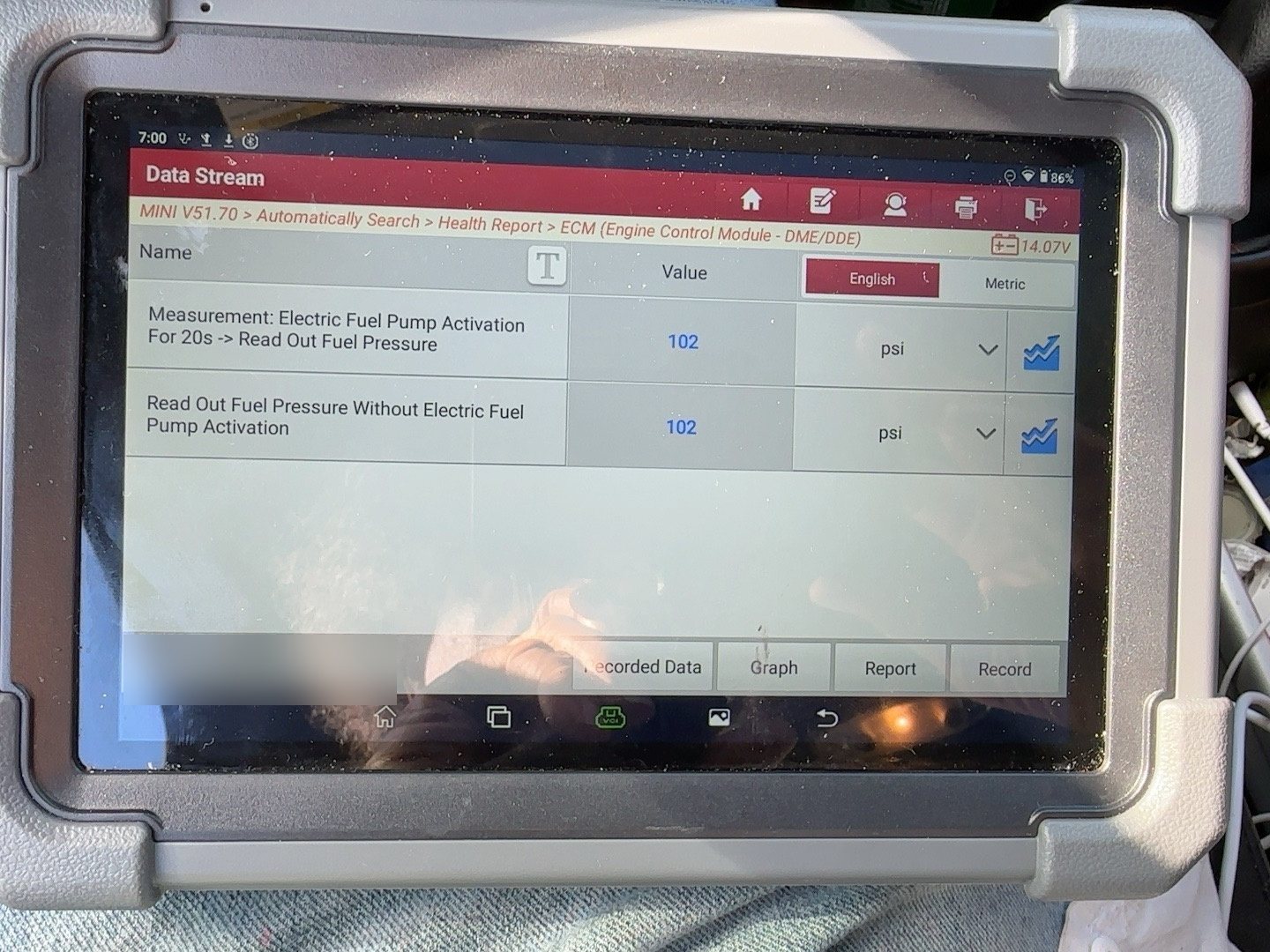
Fuel delivery. Both sides of the fuel system were watched with the scan tool. On the high side, the rail-pressure actual value sat on top of the DME's setpoint at roughly 1,023 psi. On the low side, the in-tank pump held about 102 psi (7 bar). A car that cannot reach highway speed because of fuel starvation shows actual pressure falling away from the setpoint under demand; this one did not.
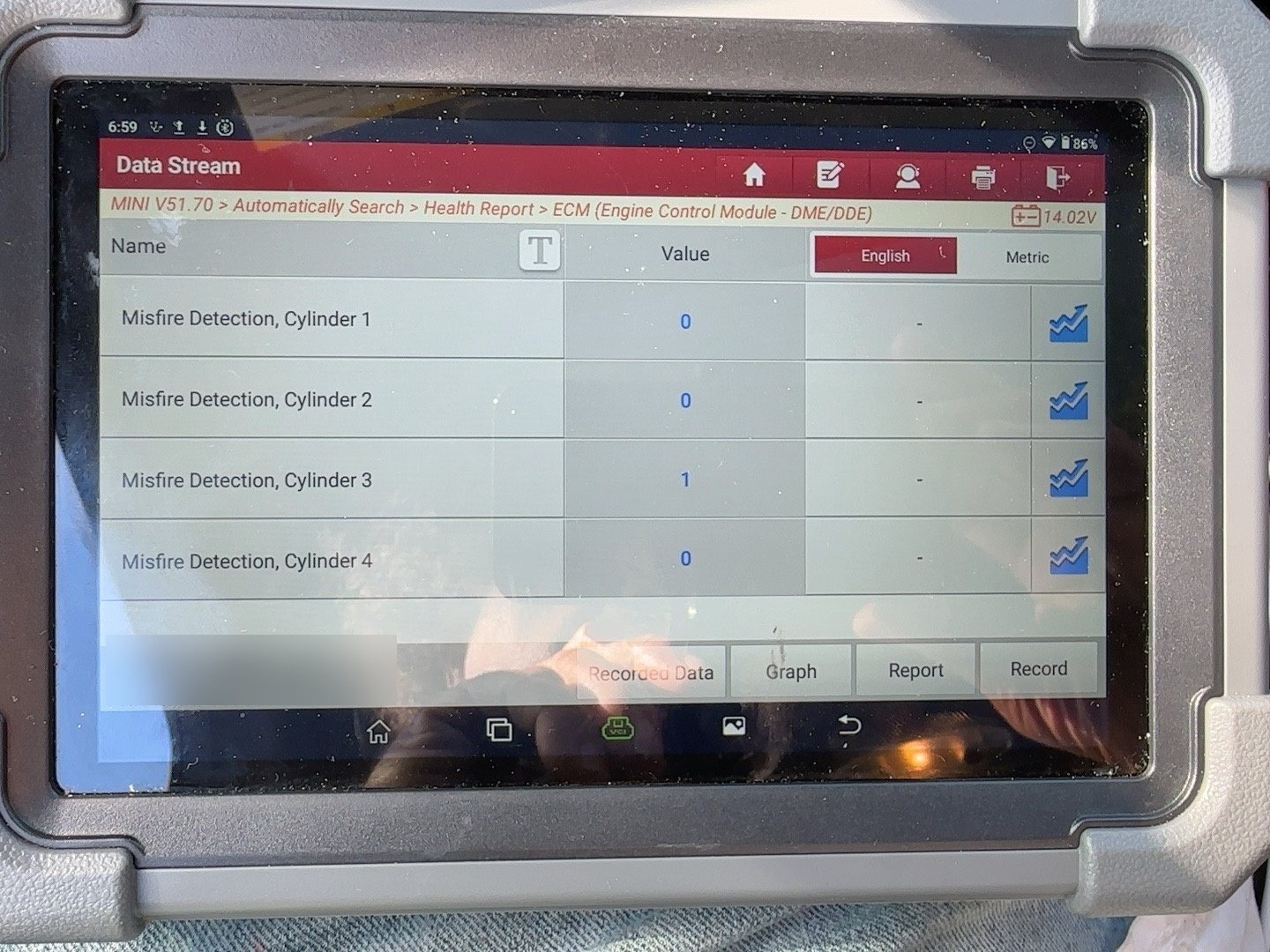
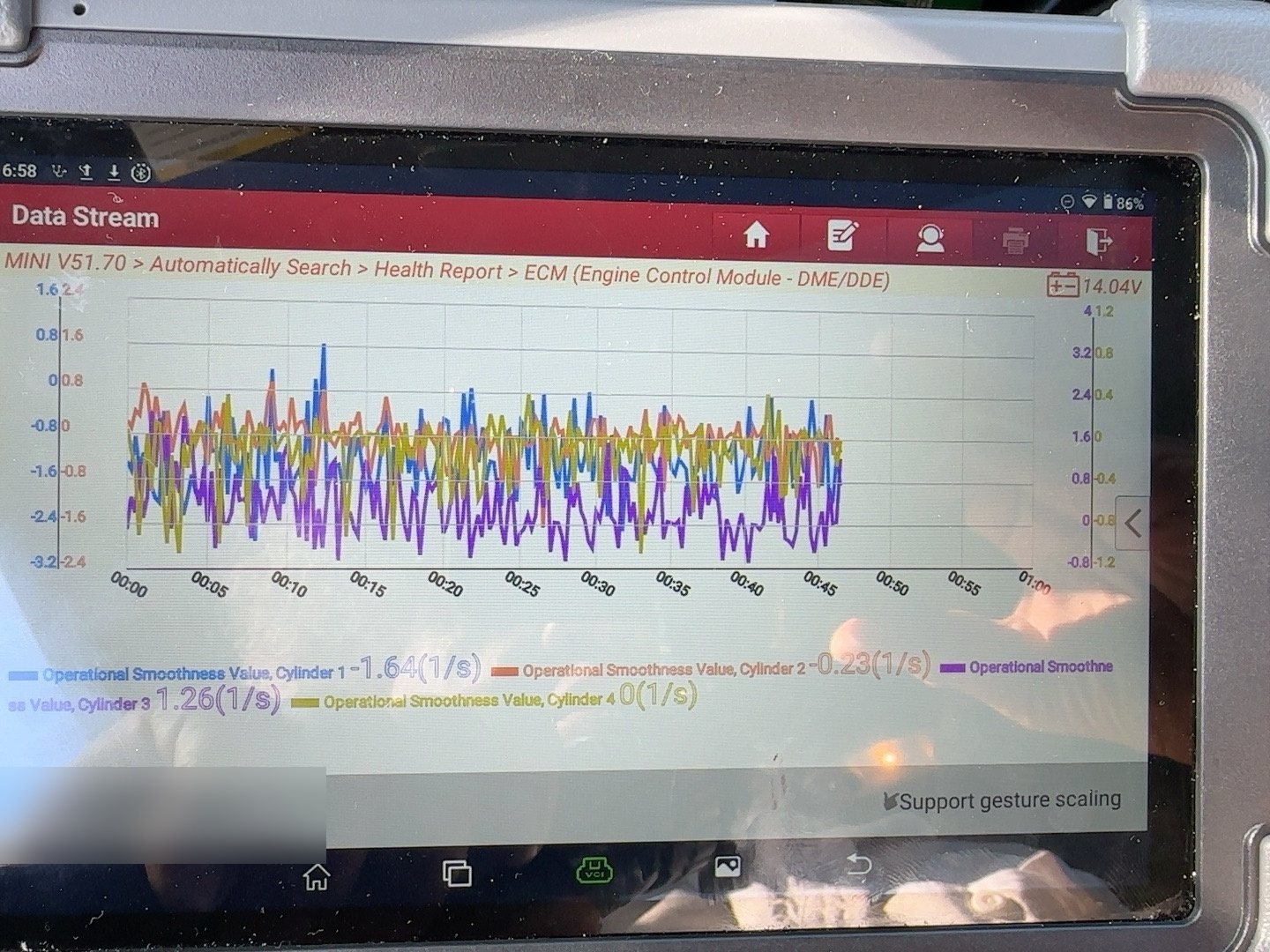
Misfire and smooth-running data. The misfire counters read 0, 0, 1 and 0 for cylinders one to four, and the operational-smoothness values for all four cylinders sat close to zero. A single logged event on cylinder three is worth noting in the file, but a single event cannot produce a car that will not hold highway speed. A misfire severe enough to do that would show up as a counter climbing on every drive, a rough idle, a flashing engine light or a smooth-running value well away from the others. None of that was present.
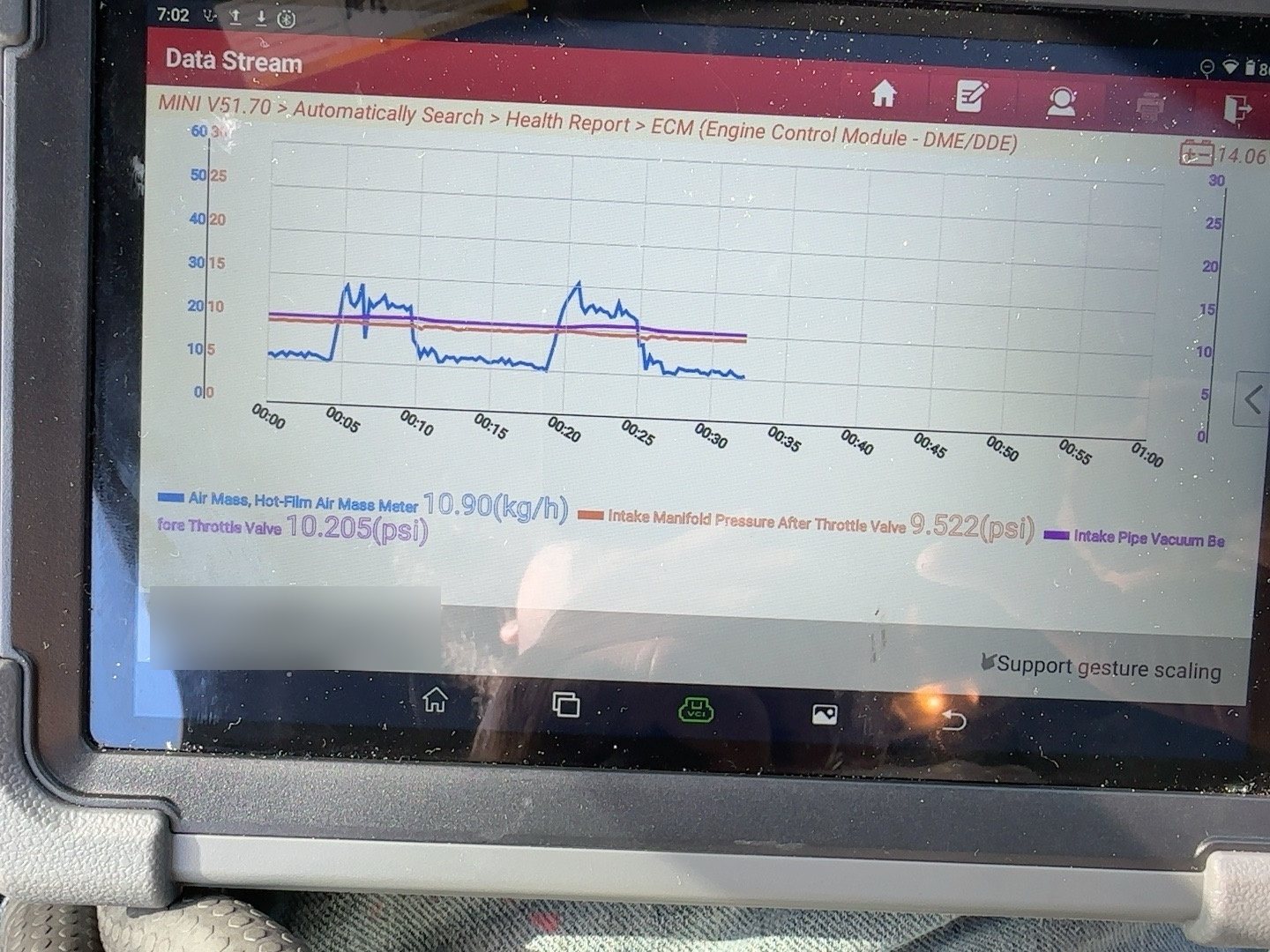
Airflow and manifold pressure, honestly labelled. Mass air flow and intake manifold pressure were watched live while revving the engine in the bay, and a short recording was made. Both signals moved together and responded to the throttle, which is what a stuck or noisy sensor does not do. What this does not show is boost. A free-revving engine with no load never builds meaningful charge pressure, so these traces were never treated as a substitute for a loaded boost test. They ruled out obviously bad sensors; they did not clear the turbo. That question was deliberately left open until the drivetrain had been ruled in or out.
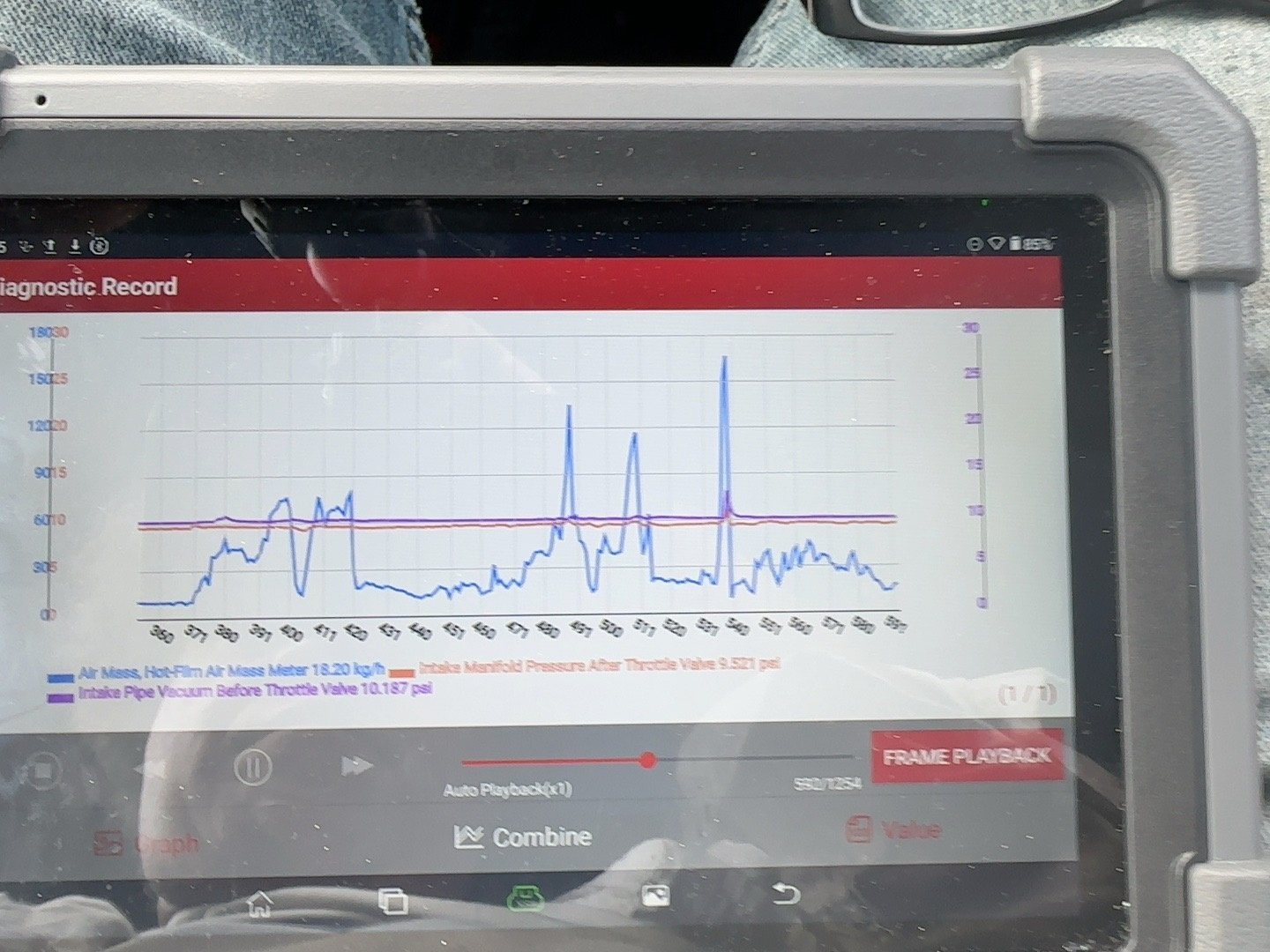
The road test decides it. With the engine data showing nothing that explained the complaint, the car was driven under load. The test that matters here is simple. In any gear, with the clutch pedal fully released, the engine and the road wheels are locked together through the gearbox. If the engine speeds up, the car has to speed up with it — the two needles on the cluster should climb together. On this car, in second gear with the pedal all the way up and the throttle down, engine speed rose roughly 1,000 to 1,500 rpm while the speedometer did not rise to match. The engine was making power; the power was not reaching the wheels. That is the signature of a slipping clutch.
Two other observations supported it. The clutch engaged very high in the pedal travel, which is consistent with a disc that has little material left or a pressure plate that is not clamping as designed. After the loaded drive there was a distinct friction or brake-like odour, which is what a clutch disc smells like when it is being dragged rather than gripped. Clutch slippage under load was confirmed.
Why this was not a turbo problem in disguise. A car down on boost pulls weakly, but engine rpm and road speed still climb together because the clutch is still transferring whatever torque the engine makes. A car with a slipping clutch does the opposite: the engine runs away from the road speed. The road test separated the two in a way no scan tool could, and it did so without replacing a second diverter valve.
Repair Performed
No repair was performed at this visit. This case study documents the diagnosis only.
The recommendation is transmission removal and physical inspection of the clutch assembly and the parts around it:
- Clutch disc — remaining friction material, glazing, hot spots, contamination
- Pressure plate — clamp load, warping, heat discolouration
- Dual-mass flywheel — surface condition, free play, damper condition
- Release bearing and clutch fork / pivot
- Slave cylinder and release hydraulics
- Rear main seal area and transmission input-shaft seal area for oil or fluid leakage
- Any evidence of contamination on the friction surfaces
The owner reports the clutch was replaced approximately 25,000 miles ago. A clutch that slips this early has a reason, but that reason is on the bench, not in the scan tool. No claim is made here about the previous installation, the parts used, driver habits, oil contamination, flywheel condition or the release system. Those are the questions the teardown exists to answer.
Verification
- Full-vehicle scan performed before any parts were considered; three unrelated faults recorded
- No boost, fuel-pressure, throttle, VANOS or significant misfire fault stored in the DME
- High-pressure fuel actual observed tracking the DME setpoint at approximately 1,023 psi
- Low-side fuel pressure observed at approximately 102 psi (about 7 bar)
- Misfire counters 0 / 0 / 1 / 0 and smooth-running values near zero for all cylinders
- Mass air flow and manifold pressure signals responsive while revving in the bay; not presented as a boost test
- Loaded road test in second gear, clutch fully released: engine rpm rose roughly 1,000 to 1,500 rpm without a matching rise in road speed
- Very high clutch engagement point and friction-like odour noted
- Clutch slippage under load confirmed; transmission removal and inspection recommended
Post-repair verification is not claimed. It belongs to the follow-up visit described below.
Technician Notes
The customer's theory was reasonable. A Countryman S that will not pull onto the highway does feel like a boost problem, and this car had a diverter-valve history. The point of the full scan and the live-data pass was not to humour that theory but to give it a fair hearing before spending money against it. When the data did not support it, the next step was to test the part of the car the scan tool cannot see.
It is worth being precise about what the engine data proves. Clean fuel pressure, clean misfire counters and a tidy smooth-running graph do not prove the turbo is good. They prove that the engine was not the system starving the car of speed in the way those signals would reveal. The loaded boost test that would finish the turbo question was set aside on purpose, because a slipping clutch makes any road-load boost measurement meaningless — you cannot load the engine properly through a clutch that will not hold.
The road-test finding is the whole case. Engine rpm climbing while road speed stands still, in gear, with the pedal up, is not ambiguous. Combined with the high engagement point and the smell, there is no other reasonable explanation that survives contact with the evidence.
The 25,000-mile history is the part to be disciplined about. It is tempting to name a cause — a bad part, a bad install, a leaking seal, a heavy left foot — and every one of those is possible. Every one of them is also unproven until the transmission is out. This write-up will be updated once that work is done.
On the three stored codes: 387F points at a key-off current draw that is worth a separate parasitic-draw test; A8BD is a plate lamp; 9C90 is the climate unit. They are all real, they are all on the list, and none of them is why the car came in.
Lessons Learned
- A customer's diagnosis is a starting hypothesis, not a work order. Give it a fair test, then follow the evidence.
- Scan the whole car before touching a part, especially when a previous part swap did not fix the complaint.
- A clean engine scan does not prove every engine component is good. It proves the DME saw nothing outside its monitored windows.
- Fuel pressure that tracks its setpoint under demand rules out fuel starvation for that demand. It says nothing about the clutch.
- One misfire event on one cylinder is a note in the file, not an explanation for a car that cannot hold highway speed.
- Do not present free-revving airflow and manifold-pressure data as a boost test. An unloaded engine does not build boost.
- In gear with the clutch released, engine speed and road speed must rise together. If the engine runs away from the speedometer, the clutch is slipping.
- A slipping clutch invalidates any road-load boost test. Settle the drivetrain question first.
- A clutch that fails early has a cause, and the cause is found on the bench. Do not assign it from the driver's seat.
Final Outcome
The poor-acceleration complaint on this 2016 Countryman S ALL4 was diagnosed as clutch slippage under load, confirmed on a road test where engine speed rose roughly 1,000 to 1,500 rpm in second gear, clutch fully released, without a matching rise in road speed. A very high engagement point and a friction-like odour supported the finding. The turbocharger and diverter valve the owner suspected were not implicated by any stored fault or live-data reading, and no boost-side part was replaced. The three stored faults — 387F, A8BD and 9C90 — were recorded as separate items unrelated to the complaint.
Transmission removal and physical inspection of the clutch disc, pressure plate, dual-mass flywheel, release bearing, fork and hydraulics, along with the rear main and input-shaft seal areas, has been recommended. The clutch is reported to have been replaced about 25,000 miles ago; the reason it is slipping now is deliberately left open until the parts are inspected.
Customer Feedback
The owner came in expecting a second turbo-side repair and was walked through a different answer and the data behind it: the scan results, the fuel-pressure and misfire screens, and then the rpm-versus-speed behaviour on the road test. The recommendation for transmission removal and clutch inspection was explained along with the reason no cause for the early slip is being named yet. Feedback after the teardown and repair will be recorded in the follow-up section.
Follow-Up: Teardown and Repair
This section is reserved for the next stage of the job and will be completed once the transmission has been removed. It will document:
- Teardown findings for the clutch disc, pressure plate, dual-mass flywheel, release bearing, fork and pivot, slave cylinder and release hydraulics
- Condition of the rear main seal and transmission input-shaft seal areas, and any contamination found on the friction surfaces
- Photographs of the removed components
- The root cause identified from the physical evidence, if one can be established
- Parts installed
- Post-repair road-test verification: engagement point, rpm-versus-speed behaviour under load in second and higher gears, and whether the acceleration complaint is resolved
- Whether the deferred loaded boost test is still needed once the clutch holds
Until that section is written, nothing about the cause of the early clutch failure should be read into this case study.
Questions About This Repair
Why was the turbo not the first thing replaced?
Because nothing in the data pointed at it. The engine module held no boost, fuel-pressure, throttle or VANOS faults, fuel pressure tracked its setpoint, and misfire and smooth-running data were clean. Replacing a diverter valve behind a complaint like this would have been a guess, and the previous diverter-valve replacement had not solved it.
How does a slipping clutch feel from the driver's seat?
The engine revs freely while the car lags behind. In a gear with the clutch pedal fully released, engine rpm and road speed should climb together. When rpm rises 1,000 rpm or more and the speedometer barely moves, the clutch is not transferring the engine's torque to the gearbox.
Why did the scan tool not show a clutch problem?
A conventional clutch on a manual transmission has no sensor that measures how well it grips. The DME sees engine speed, and the vehicle sees road speed, but neither module is programmed to flag a mismatch between them as a clutch fault on this car. The clutch has to be tested by driving it under load.
What do the stored faults 387F, A8BD and 9C90 mean?
387F is a DME power-management fault recording a closed-circuit (key-off) current violation. A8BD is a footwell-module fault for the number-plate light. 9C90 is an internal fault in the climate-control unit. All three are real findings, and none of them can make a car accelerate poorly.
The clutch was replaced about 25,000 miles ago. Was it installed wrong?
That cannot be answered until the transmission is out and the parts are on the bench. A clutch can slip early because of the disc, the pressure plate, the flywheel, the release mechanism, a hydraulic fault, oil contamination or the way it has been used. Naming a cause before seeing the parts would be guessing, so this write-up does not.
What happens next?
Transmission removal and a physical inspection of the clutch disc, pressure plate, dual-mass flywheel, release bearing, fork and hydraulics, plus the rear main and input-shaft seal areas. The findings, photographs, parts fitted and post-repair road test will be added to this case study when that work is done.
Why watch airflow and manifold pressure if they were not a boost test?
Watching the mass air flow and manifold pressure signals while revving the engine in the bay shows whether the sensors respond sensibly and whether anything is stuck or noisy. An unloaded engine does not build meaningful boost, so those readings say nothing about boost under load and were never presented as if they did.
Repairs Like This One
- 9 documented Diagnosis repairs. See them all →
- 8 documented Engine repairs. See them all →