2012 MINI Cooper R56 Intermittent Battery No-Start: Multi-Day Test Data
Quick Summary
A 2012 MINI Cooper Base (R56, automatic) arrived with a history of intermittent battery no-starts after parking. Repeated jumps had been necessary, and the owner reported that disconnecting the battery while parked seemed to prevent the problem. Rather than immediately replace parts, the shop recorded serial battery measurements, monitored connected overnight periods, checked cranking and charging and inspected connections. A negative-terminal contact irregularity prompted cleaning of both posts and terminals. The reported no-start was not reproduced through October 7, 2026; the final diagnosis remained provisional.
- Vehicle
- 2012 MINI Cooper (R56)
- Difficulty
- ★★★☆☆
- Repair Time
- Not documented hours
- Outcome
- Customer-reported overnight no-start not reproduced during multiday testing; inconsistent battery-terminal contact observed and connections cleaned; continued monitoring pending
Fault Codes
Vehicle Information
| Year | 2012 |
|---|---|
| Model | Cooper |
| Chassis | R56 |
| Transmission | Automatic |
| Mileage | Not documented |
Repair Timeline
- Prior history Complaint Repeated jump starts after parking; disconnecting the battery between drives reportedly prevented the issue; a second battery had reportedly behaved similarly.
- October 4 Diagnosis Multiple connected-battery conductance readings remained GOOD, with 12.47–12.51 V and 813–875 measured CCA.
- October 5 Diagnosis Inconsistent electrical probe contact at the negative terminal led to cleaning of both battery posts and cable-terminal connections.
- October 6 Verification Following overnight parking with the battery connected, vehicle started normally with 10.76 V minimum during cranking; several further readings remained GOOD.
- October 7 Verification After about 21.5 hours parked connected, vehicle again started normally; stable charging observed at idle with multiple electrical loads.
Customer Complaint
The owner reported a battery appearing discharged after roughly a day parked, sometimes requiring repeated attempts to jump-start. A second battery reportedly showed the same problem. The complaint began before the recent battery swaps. Disconnecting the battery when the car was parked reportedly prevented the symptom. The owner wanted the cause investigated, not another speculative battery replacement.
Symptoms
- Historical intermittent no-start / apparent battery discharge after parking
- Multiple jump starts reported by the customer
- Complaint absent during the documented multiday shop observation
- Battery conductance tests consistently marked GOOD
- Inconsistent electrical probe contact at the negative battery-terminal connection
- Separate road-test observations: warm A/C and unstable front-end behavior over bumps, neither formally diagnosed in this battery case
Diagnostic Process
The installed EverStart Plus Group 34 flooded 12 V battery was labeled 700 CCA / 875 CA. Conductance testing repeatedly reported 100% estimated state of health and GOOD. State-of-charge figures below are tester estimates, not independent capacity measurements.
Recorded battery tests
| Date / checkpoint | Battery voltage | Measured CCA | Internal resistance | Estimated SOC | Tester |
|---|---|---|---|---|---|
| Initial, after overnight charging | 12.57 V | 813 | 3.83 mΩ | 96% | GOOD |
| Oct 4, ~1:02 PM | 12.51 V | 816 | 3.82 mΩ | 88% | GOOD |
| Oct 4, 6:58 PM | 12.50 V | 813 | 3.83 mΩ | 87% | GOOD |
| Oct 4, 9:39 PM | 12.47 V | 875 | 3.56 mΩ | 83% | GOOD |
| Oct 5, 9:17 AM | 12.47 V | 825 | 3.78 mΩ | 83% | GOOD |
| Oct 5, 7:34 PM, after ~1-hour drive; before cleaning | 12.44 V | 844 | 3.69 mΩ | 80% | GOOD |
| Oct 5, 7:58 PM, after terminal cleaning | 12.55 V | 827 | 3.77 mΩ | 93% | GOOD |
| Oct 5, 8:55 PM, after short drive | 12.64 V | 823 | 3.79 mΩ | 100% | GOOD |
| Oct 5, 9:13 PM | 12.63 V | 823 | 3.79 mΩ | 100% | GOOD |
| Oct 6, 7:09 AM, after connected overnight parking | 12.55 V | 830 | 3.75 mΩ | 93% | GOOD |
| Oct 6, 6:47 PM, after ~11.5 hours parked connected | 12.50 V | 820 | 3.80 mΩ | 87% | GOOD |
| Oct 6, 8:42 PM, after ~1-hour drive | 12.49 V | 813 | 3.83 mΩ | 86% | GOOD |
| Oct 7, 6:21 PM, after ~21.5 hours parked connected | 12.47 V | 818 | 3.81 mΩ | 83% | GOOD |
A separate multimeter measurement immediately after the October 6 drive read about 12.63 V, whereas the conductance tester displayed 12.49 V at its recorded checkpoint. The measurements were taken with different instruments/contact points or timing; they are not presented as simultaneous equivalent readings.
The October 6 minimum cranking voltage was 10.76 V, followed by a normal start. CAS/charging observations reached approximately 14.4–14.65 V at times. The rise to charging voltage could take several seconds after starting. On October 7 the engine idled while high beams, blower on high, rear defroster and both heated seats operated; radiator fans cycled and the A/C compressor received power. Charging behavior remained stable by observation. No precise charging-current figure was recorded.
After the October 7 engine shutdown, an analog tester needle appeared near 12.6–12.8 V; this is an approximate visual reading immediately after running, not a rested or precision voltage measurement.
Shutdown/sleep-current checks were also attempted. The R56 parking-indicator lamp sometimes remained illuminated for roughly 30 minutes. A low-range clamp meter indicated fluctuating values, but offset drift and limited resolution at sub-amp levels made the observations unsuitable to establish a firm parasitic-draw value. Neither an intermittent drain nor a specific failed module was established.
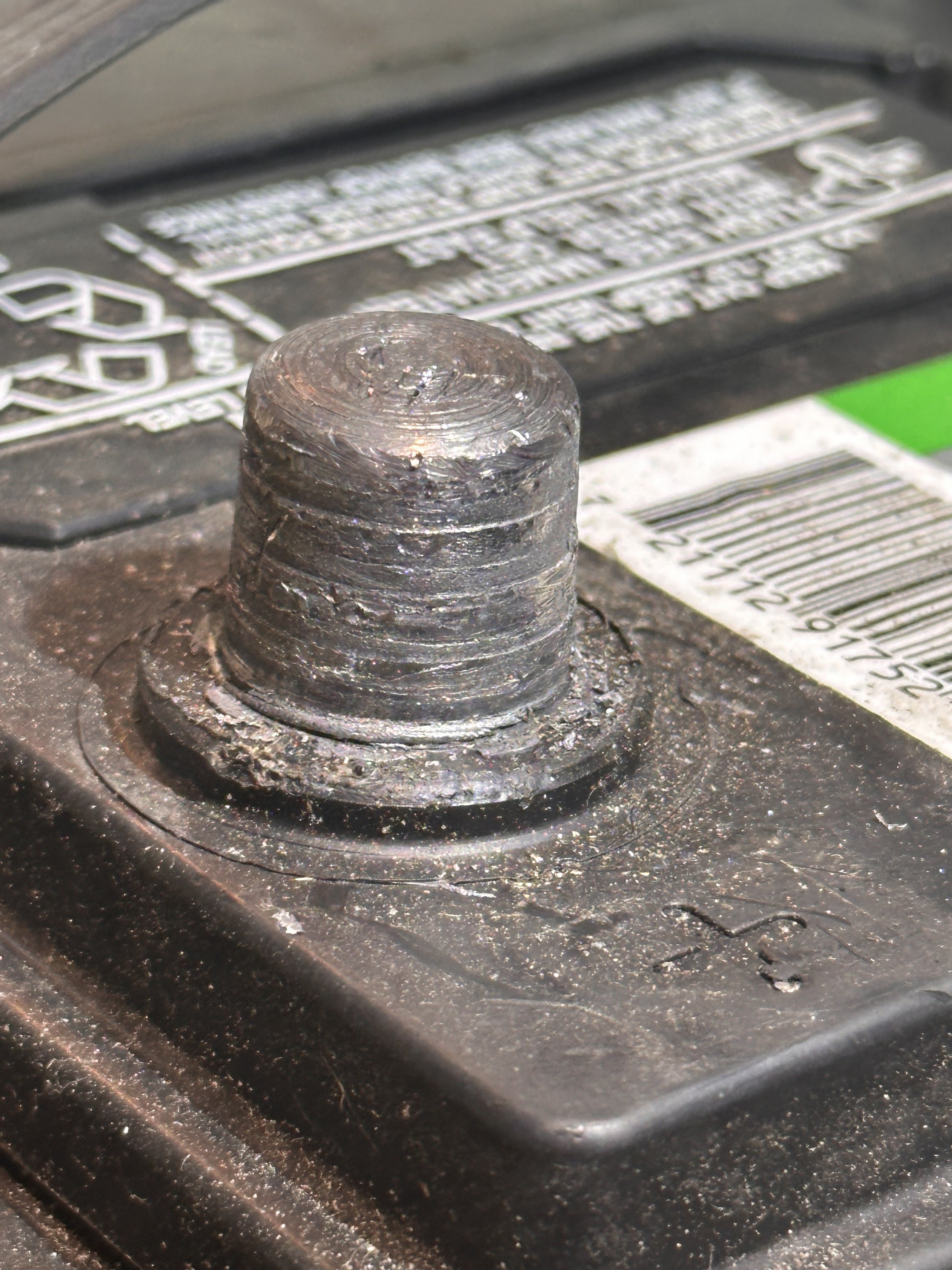
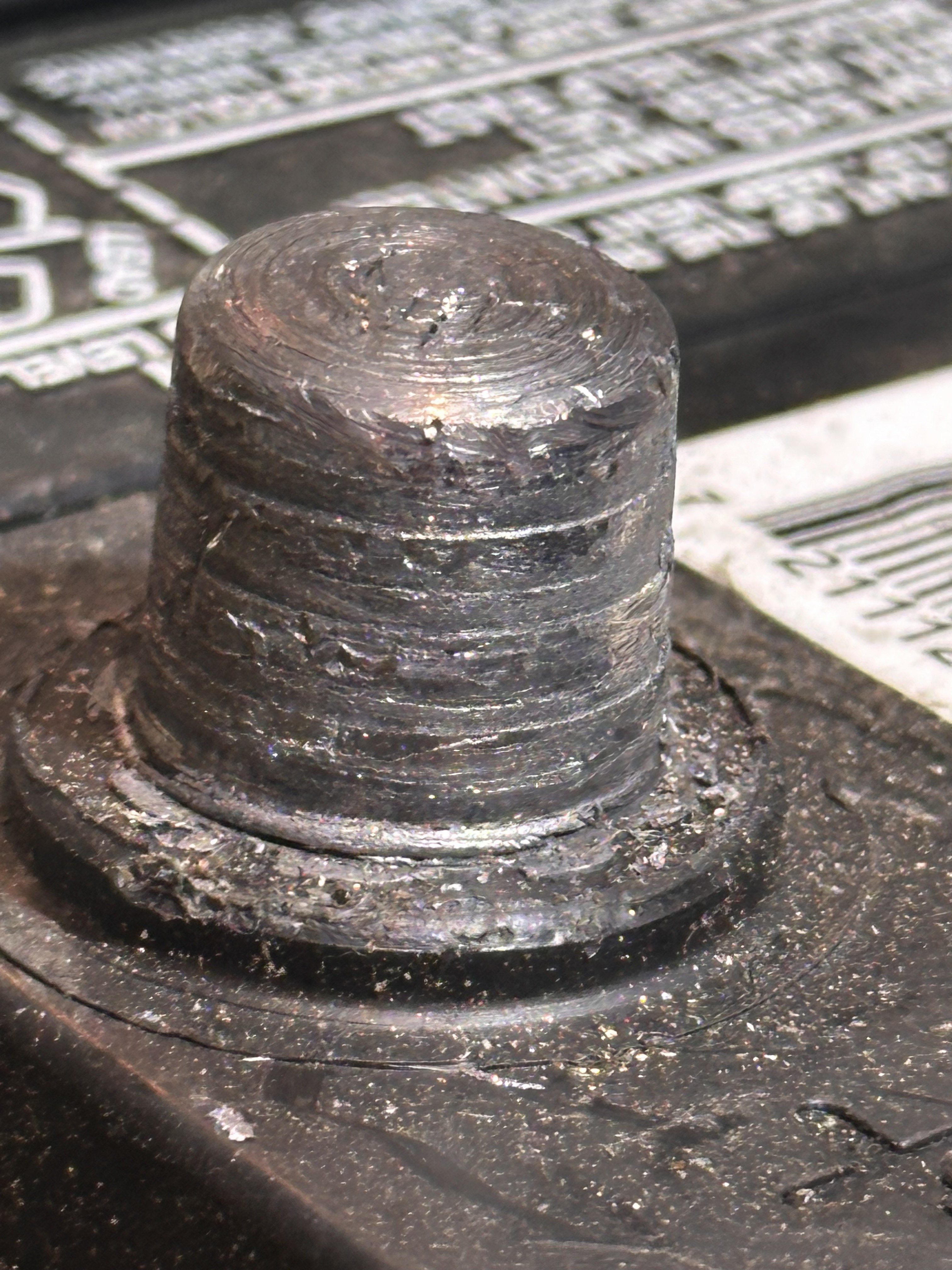
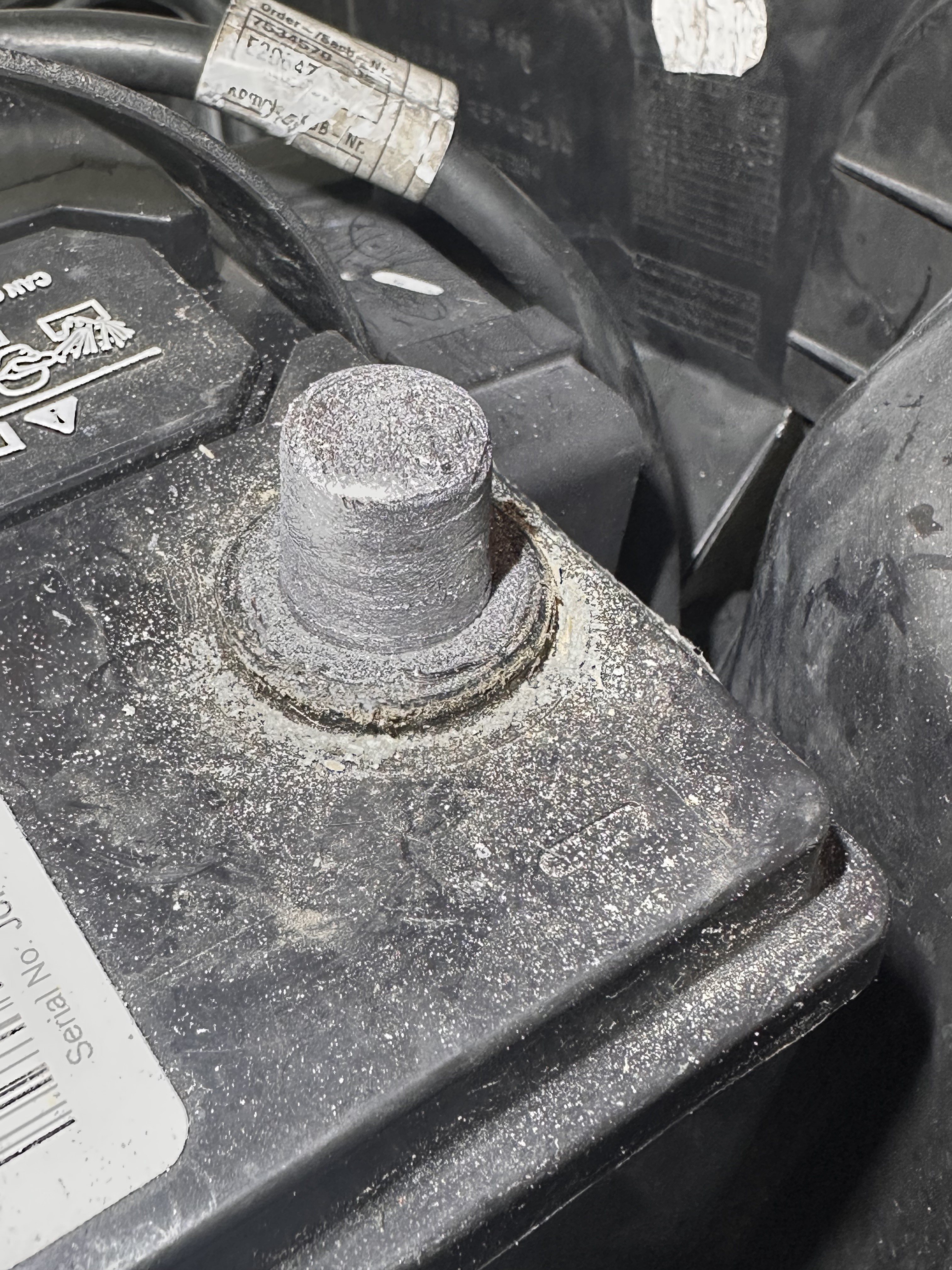
A battery-connection issue emerged when probing the negative terminal: contact was inconsistent at parts of the terminal and a connected tester sometimes did not power on. Both battery posts and terminal connections were cleaned. Afterward, measured static battery-post and clamp voltages were 12.60 V and 12.61 V respectively. This showed similar unloaded readings but was not a loaded voltage-drop test, nor conclusive proof that the original complaint was resolved.
Repair Performed
- Inspected battery connection contact following inconsistent negative-terminal probing
- Thoroughly cleaned battery posts and terminal connections
- Retested battery condition after cleaning
- Left the battery connected for subsequent monitored parked intervals without external charging
- Continued starting, idling, load observation and selected road tests
No battery, cable, alternator, CAS, DME or other electrical module was documented as replaced. No battery registration was claimed.
Verification
By the October 7 checkpoint, connected-battery readings remained GOOD and the car repeatedly started normally following extended parked intervals, including overnight and approximately 21.5 hours. October 6 cranking minimum was 10.76 V. Charging appeared stable under the documented electrical loads. The owner’s reported rapid no-start condition had not been duplicated; longer-term results after vehicle return were not yet available.
Technician Notes
An above-rated measured CCA on a conductance tester should not be confused with a full reserve-capacity test. Nor should similar static post-to-clamp voltages replace testing under load when diagnosing contact resistance. Given the strong repeat measurements and the actual intermittent terminal contact observed, servicing the connections was justified without condemning the battery. If symptoms return, perform controlled voltage-drop checks across the negative terminal, ground cable and chassis/engine grounds under load, inspect connection security, and use a suitably accurate instrument/data logger for true extended sleep-current testing.
Unrelated findings during driving: The air conditioner blew warm and intermittent hissing/refrigerant-flow noise was heard. The front end also felt unstable when hitting bumps, suggesting possible suspension/steering looseness, including control-arm bushings as a possibility. Neither was inspected sufficiently to assign a failed part. Further A/C diagnosis and a priority suspension/steering safety inspection before normal driving were recommended.
Lessons Learned
- Reproduce an intermittent complaint before recommending expensive parts.
- Record battery state at repeatable parked intervals while leaving the vehicle connected.
- Confirm terminal contact quality; repeatedly reinstalling a cable does not guarantee a clean low-resistance connection.
- Distinguish estimated state of charge and conductance-measured CCA from actual reserve-capacity testing.
- Do not treat a low-resolution DC clamp reading as definitive evidence of a parasitic draw.
- High-load charging checks and minimum cranking voltage provide different evidence from static battery voltage.
- Document additional road-test safety concerns separately from the billed electrical diagnosis.
- Do not promote a likely explanation to a proven root cause when the symptom has not been reproduced.
Final Outcome
Interim outcome as of October 7, 2026: Battery posts and terminals cleaned after contact irregularity was observed. Repeated measurements and connected parked starts remained satisfactory. No confirmed ongoing drain or failed electrical component was identified. Pickup was scheduled for October 10, with final checks still pending. This case should be updated if later testing or customer follow-up establishes a definitive outcome.
Customer Feedback
No post-service customer feedback had been documented as of this case-study draft.
Questions About This Repair
Did the battery fail?
No. Repeated conductance tests returned GOOD and measured above its stated 700 CCA rating. These tests do not independently prove reserve capacity.
Was a parasitic drain confirmed?
No. Low-current clamp observations were not sufficiently precise or repeatable to confirm or exclude an intermittent drain.
What repair was performed?
Both battery posts and terminal connections were cleaned after inconsistent contact was observed. No battery, alternator or module replacement was documented.
Was the original no-start complaint fixed?
It was not reproduced through the latest documented October 7 check. A definitive root-cause confirmation and long-term outcome were still pending.
Repairs Like This One
- 15 documented Electrical repairs. See them all →
- 13 documented Diagnosis repairs. See them all →